I’m writer and genealogist Janice Hamilton. I have been researching and writing about my ancestors on this blog since 2013. Most of them came from Scotland, England or Ireland in the early 1800s, establishing new roots in Canada and the United States. Hamilton, Forrester, Rixon, Glendinning, Stobo, Bagg, Smithers, Shearman, Mulholland and Mitcheson are some of the families I have researched. To search this blog for a name, place or topic, use the search box on the top right, the categories listed on the left or bottom, or scroll to the bottom to check the dated Archives.
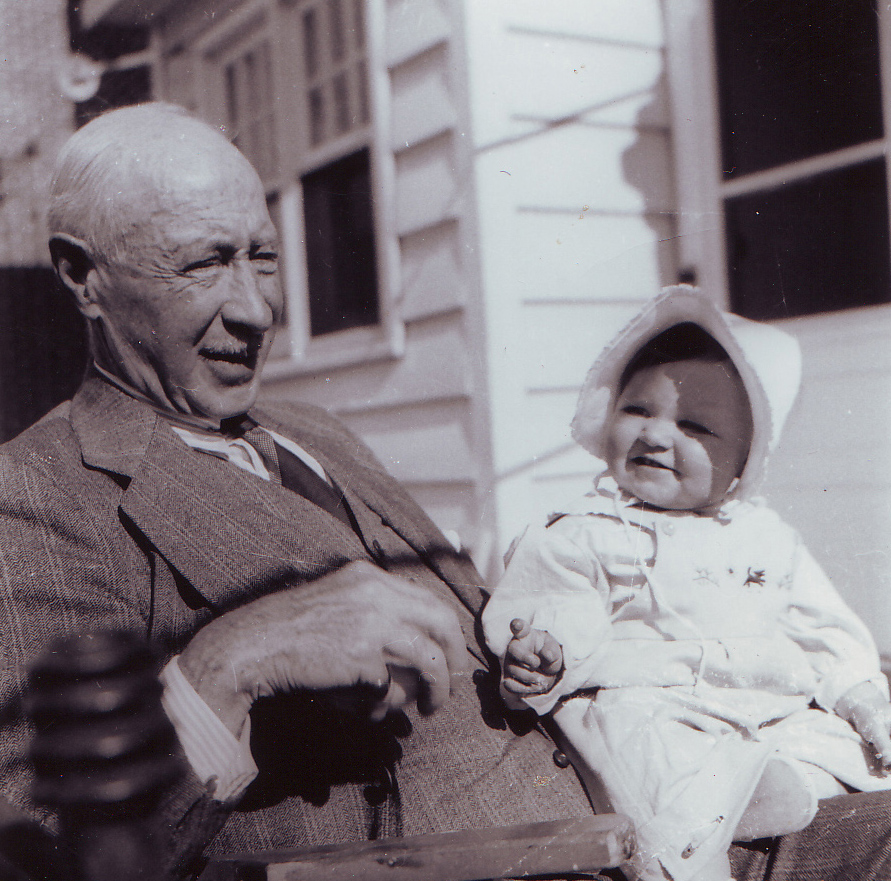
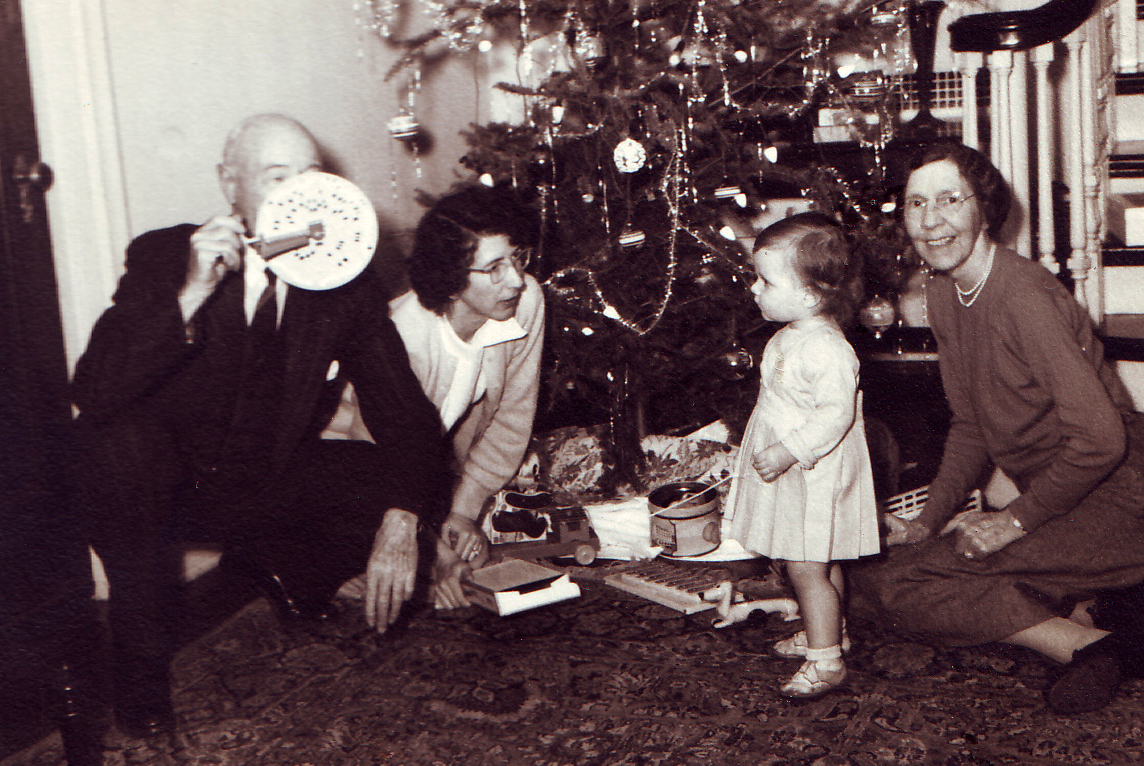
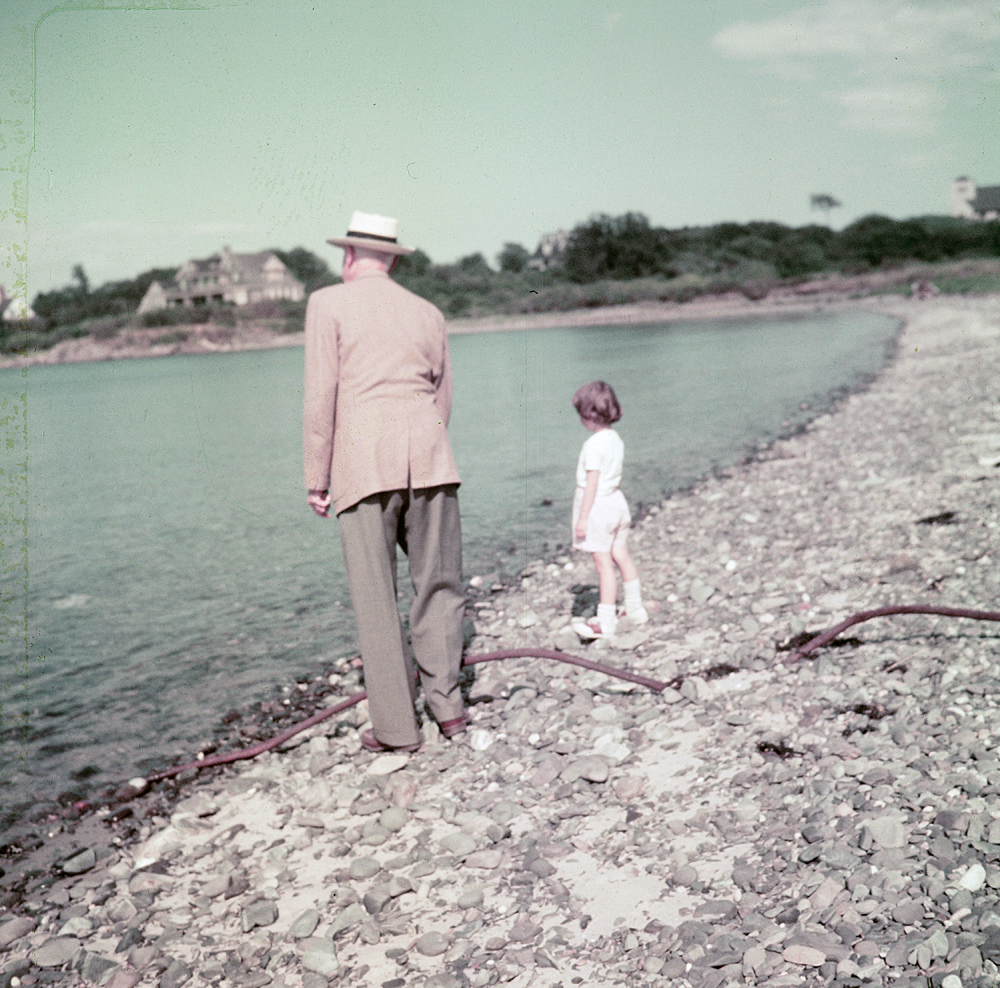
I was just eight years old when Grampy, my mother’s father, died, so I have few memories of him, only photos. There’s one of him holding me on his lap when I was about a year old, and another that shows him playing a toy musical instrument. A shot of him demonstrating his stone-skipping skills on a Maine beach was probably taken in 1956, during the last summer of his life.
At that time, children were to be seen and not heard; not all grandparents were as involved as he was, and that makes these photos all the more special. In fact, he was close to all the women in his family, young and old, as he provided moral support and financial guidance to his mother and his three unmarried sisters, as well as to his wife and his daughter.
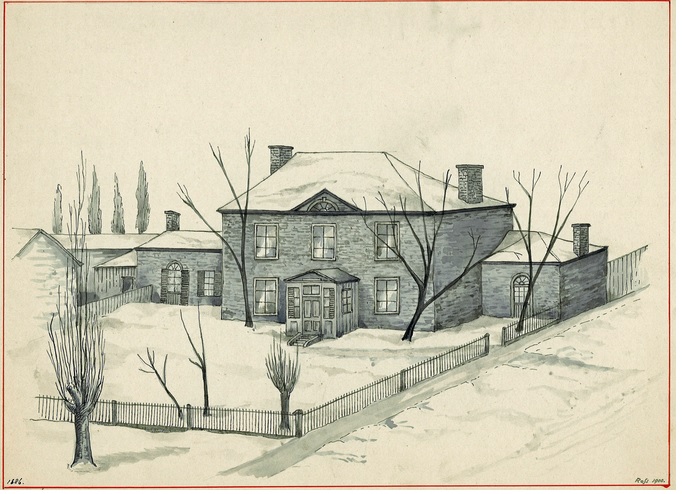
Frederic Edmund Murray Smith was born in Montreal in 1879 to Jane Mulholland and her husband, John Murray Smith, a bank manager. Fred was the third of their six children. His was a life of privilege, as the family lived in a grey-stone house on McGregor Avenue (now Dr. Penfield Avenue), on the slope of Mount Royal. They also had a summer cottage on the shores of Lake St. Louis, in what is now one of Montreal’s West Island suburbs.
But in 1891, Fred’s seventeen-year-old brother, Henry, died of appendicitis. Three years later, when Fred was just 15, his father succumbed to a heart attack, and Fred became the man of the family.
Women supposedly did not understand money matters, so his mother and sisters looked to him for advice. For example, many years later, when his sisters finally sold the house on McGregor, the task of handling the sale and helping them move to an apartment fell on Grampy’s shoulders.
Fred decided not to attend university, but started his career as a messenger. It did not take long for him to move up the corporate ladder. In 1918, he was a manager with the Royal Bank of Canada, and in the late 1920s, he was with Verret Stewart Co., a firm that was an agent for Windsor Salt. Between 1930 and 1936, there was no profession listed beside his name in the Montreal Lovell’s street directory, but he went to work as treasurer of Champlain Oil after the depression and stayed there until he retired.
Fred, Joan, Janice, Gwen around 1950
He lived at home with his mother and sisters and remained an eligible bachelor until age 37, when he married Gwendolyn Bagg. Their only daughter, Joan, was born two years later, in 1918.
Fred and Gwen were both quiet people, more interested in spending time with family than in enjoying Montreal’s night life. In fact, Fred was a strict Presbyterian who never appeared at the dining table without a jacket and tie, and would not allow my mother to play cards on Sundays. But my cousin who is 10 years older than I am remembers him as kind and having a good sense of humour.
In a 1946 letter to my father, Fred described his view of marriage: “We … hope that you both may have as happy a life together as your future father-in-law had in his married life, keeping in mind that it is a partnership, which means both of you have to give and take, and that in the home, it is the woman’s department.”
For the first dozen years of their lives together, the Murray Smiths lived on tiny Selkirk Avenue, near the corner of Cote des Neiges and Sherbrooke streets, two short blocks away from Gwen’s mother’s house and several long blocks from Fred’s mother’s house.
skipping stones, around 1956
In the late 1920s, my grandparents decided to build a larger house. According to my mother, when they looked at the architectural plans, they did not realize how big it would be. Not only was the house more than they needed, but their timing was bad since Fred lost his job during the depression. Fortunately, Gwen’s Aunt Amelia Norton helped out financially, but this must have been hard for Fred. He was accustomed to helping others. My grandparents lived in that house for the rest of their lives, and he died there, of a heart attack, at age 77.
Grampy is buried in the Murray Smith family plot at Mount Royal Cemetery with his father, mother, brother, three sisters and wife. My mother is buried with them.
This article is also posted on the collaborative blog https://genealogyensemble.com
Notes:
Legally, the family name was Smith, however, because Smith was such a common name, the family used Murray Smith as if it were a hyphenated last name.
The row house on Selkirk Ave. is still there, the Murray Smith family home on McGregor was demolished to make way for a high-rise apartment building, and my grandparents’ house on Saint-Sulpice became the Iraqi consulate.
Clark Street in Montreal’s Mile End neighbourhood features two-storey row houses, most of them red brick or grey stone, set back a few feet from the sidewalk. Two hundred years ago, this now densely populated street was just a gleam in the eye of my four-times great-grandfather John Clark (1767-1827), who owned that land. Today, Clark Street looks remarkably similar to the way he envisioned it.
Mile End Lodge
John must have foreseen that his farmland would someday get swallowed up by the expanding city. He wanted to see it developed properly, and he wanted his descendants to profit from it. Thus, he carefully outlined his development vision in his last will and testament.
A native of County Durham in northeast England, John Clark1 immigrated to Montreal with his wife, Mary Mitcheson, and their young daughter around 1797 and he became a butcher and an inspector of beef and pork.
He probably had a nest egg of cash because he soon bought property here. In 1799, he purchased a property on Montreal’s La Gauchetière Street. Perhaps the Clark family lived there. When he sold it 11 years later, the deeds showed it to be a double lot including two houses and several other buildings..2
Between 1804 and 1814, John purchased several neighbouring farms north of the city limits of Montreal.3 He purchased these properties from French Canadian farmers, then named them Mile End Farm, Blackgate Farm and Clark Cottage Farm. The land, including several houses, barns, stables and outbuildings, was on the west side of Saint Lawrence Street, now known as Saint-Laurent Boulevard and one of the city’s major arteries. At the time, this was the main road to the countryside, leading past the eastern flank of Mount Royal to the Rivière des Prairies on the north side of Montreal Island.
The area was rural, consisting primarily of fields of wheat, oats and peas, as well as pastureland, fruit orchards and woodlots. Both John and Mary had grown up in rural England, so they preferred to live in the countryside rather than in the crowded city. The Clarks’ grey stone house, called Mile End Lodge, was built around 1815 on Saint Lawrence Street, between what are now Bagg and Duluth streets. They had few neighbours: most Montrealers, especially recent immigrants from Britain like them, lived in town.
Land ownership was important. It conferred social status, it carried the right to vote, and land was a financial tool, commonly used as security for loans. I do not know for sure why John purchased so much land, but even in the short term, it was a smart decision: the soil was fertile and the area was close to the city, where there was a growing demand for meat and produce.
John probably wanted to graze his own cattle on that land, and to grow timothy hay for them. Meanwhile, in 1816, he placed an advertisement in the Montreal Herald saying he was willing to pasture cattle on his property for between eight and 10 shillings per cow.4
John probably collected rental income from these farms. It was not uncommon for members of the city’s elite, and for skilled tradesmen such as John, to purchase land and rent it to local farmers. He went one imaginative step further and, in 1810, leased a two-storey house on the Mile End Farm to father and son Phineas and Stanley Bagg to operate as a tavern.5 The building was located at a major intersection on St. Lawrence Street, so it was in an excellent location for thirsty travellers.
Phineas and Stanley ran the Mile End Tavern until 1818. The following year, Stanley married John’s daughter, Mary Ann. As a wedding present, John gave them a lot on St. Lawrence Street, including a two-storey house he named Durham House, that he had purchased in 1814.6
John may have had an emotional attachment to the Mile End Farm and Durham House, but he certainly saw his land as a long-term investment. The population of Montreal had increased from about 6000 in 1780 to 20,000 in 1820, and he foresaw this area would eventually be developed.
In 1825, at age 58, John wrote his will, leaving his properties to Mary Ann and to his young grandson, Stanley Clark Bagg.7
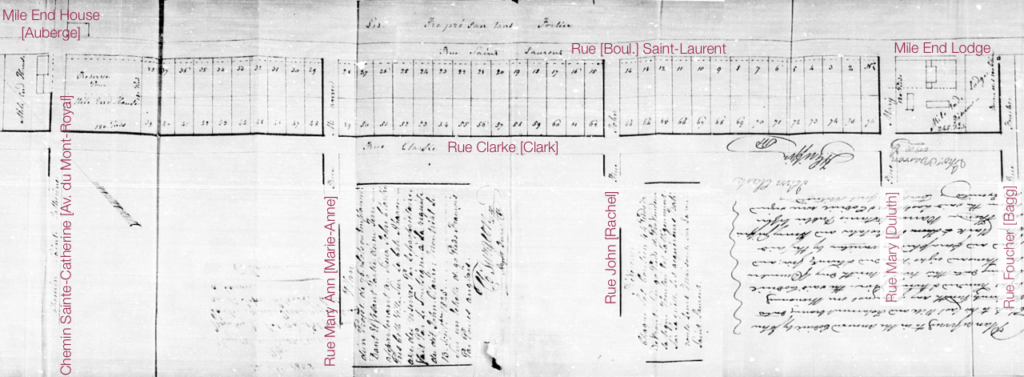
Plan for proposed subdivision of a part of Mile End Farm. The names of modern streets have been superimposed on this diagram; computer graphics by Justin Bur.
He added a codicil a few months later that included a plan for housing lots on St. Lawrence Street and on the yet to be created Clark Street, one block west. He specified that the lots should be 44 feet wide by 90 feet deep, and that the buildings should be built of stone or brick and set back from the road.8
John’s codicil also specified that the sale of the lots were subject to a rente constituée, meaning that, in addition to the initial cost of the property, the buyer was to pay the vendor an amount every year, usually about 6% of the property’s value. This was a common practice in Quebec, designed to provide funds to the seller’s family members for several generations. However, when Clark Street was finally developed decades after John’s death, buyers were not interested in this old-fashioned practice and the rente constituée was eliminated.9
Meanwhile, most of the property lines and all of the street rights-of-way shown on the plan in John’s will are still in effect today. Also, the specifications for building quality were respected, and similar conditions were imposed by neighbouring landowners.
John Clark is usually identified as an inspector of beef and pork. There was another John Clark, a master butcher, living in Montreal at the same time. That John Clark made a will in 1804, while my John Clark made a first will in 1810 and a final one in 1825.
Thomas Barron, notarial act #2876, “Deed of sale John Clark to William Scott,” 18 Oct. 1810, BAnQ.
These properties are listed in John Clark’s will, (Henry Griffin, notarial act #5989, “Last Will and Testament of Mr. John Clark of Montreal,” 29 August 1825, BAnQ) and in the inventory of his grandson’s estate (Joseph-Augustin Labadie, notarial act #16733, “Inventory of the Estate of the Late Stanley Clark Bagg Esq.” 7 June, 1875, BAnQ.)
J.A. Gray, notarial act, “Lease for five years John Clark to Phineas and Stanley Bagg,” 17 Oct. 1810, BAnQ.
The marriage contract is attached to records for lot 110, Saint-Laurent Ward, Montreal, p. 395, Registre foncier du Québec online database.
Henry Griffin, notarial act #5989, “Last Will and Testament of Mr. John Clark of Montreal,” 29 August 1825, BAnQ
Clark Street as laid out in the plan attached to John’s codicil ran from just south of the city limits (Bagg St. near Duluth) to Saint Catherine Road (now Mont-Royal Ave). Clark Street was developed in segments throughout the 19th and 20th centuries, with the first part, around Mile End Lodge, subdivided in 1873. In the early days, a section of Clark Street was called Mitcheson Street (Mitcheson was John’s wife’s name), but by 1912, it became Clark Street along its length.
The rente constituée was often used in France, England and French Canada. In those days, there was no modern money-lending system, so people could rent land for an annual sum. The borrower/purchaser could redeem the rent, however, the capital value of the property was not reduced by previous rent payments. John Clark and his grandson Stanley Clark Bagg complicated things by using testamentary substitutes to require that their real estate be subject to such arrangements far into the future. Their wills specified that the actual beneficiary was three generations down, while the intervening generations were responsible for keeping the estate in good shape for their children. When the Bagg and Clark properties were subdivided in the late 19th century, the Quebec legislature passed an act to end the substitution.
Image Credits:
Mile End Lodge, watercolour by John Hugh Ross, copyright Stewart Museum, 1970, 1847 Plan attached to codicil to the last will and testament of John Clark, December 1825, BAnQ, CN601 S187.
Further Reading:
Justin Bur, Yves Desjardins, Jean-Claude Robert, Bernard Vallee and Joshua Wolfe, Dictionnaire Historique du Plateau Mont-Royal, Montreal, Les Éditions Écosociété, 2017. Yves Dejardins,Histoire du Mile End, Québec: Les éditions du Septentrion, 2017.
Justin Bur, “À la recherché du cheval perdu de Stanley Bagg, et des origins du Mile End,” Joanne Burgess et al, Collecting Knowledge: New Dialogues on McCord Museum Collections, Montreal: Éditions MultiMondes, 2015.