I’m writer and genealogist Janice Hamilton. I have been researching and writing about my ancestors on this blog since 2013. Most of them came from Scotland, England or Ireland in the early 1800s, establishing new roots in Canada and the United States. Hamilton, Forrester, Rixon, Glendinning, Stobo, Bagg, Smithers, Shearman, Mulholland and Mitcheson are some of the families I have researched. To search this blog for a name, place or topic, use the search box on the top right, the categories listed on the left or bottom, or scroll to the bottom to check the dated Archives.
Many people have old family treasures such as letters and albums in the attic. In my family, a collection of 200-year-old business records made their way from the attic to a Montreal museum, and now some them have been digitized and placed online for everyone to explore. Part of the Bagg Family Fonds housed at the McCord Museum, these newly digitized images include records from the store where the workmen who built the Lachine Canal in the early 1820s bought their bread and rum.
The project to digitize these and other documents was financed by Library and Archives Canada to mark the 150th anniversary of Canadian Confederation and Montreal’s 375th anniversary. The McCord Museum in Montreal is posting some 75 000 images from its collection of textual archives to its website (http://collections.musee-mccord.qc.ca/en/keys/collections/).
The website provides an introduction to the Bagg family and to the scope of the Bagg Family Fonds (P70): http://collections.musee-mccord.qc.ca/scripts/explore.php?Lang=1&tableid=18&tablename=fond&elementid=31__true. At the bottom of this page are links to four sets of digitized documents: the Laprairie Brewery (1821-1832), the workmen’s store in Lachine (1822-1823), a child’s scrapbook and a young woman’s autograph book that probably dates from around the turn of the century.
My three-times great-grandfather Stanley Bagg was one of the four main contractors in charge of building the Lachine Canal in Montreal in the 1820s. He also ran the store that supplied the workers with bread, tea, sugar, pork and occasionally fish, eggs and butter, although rum and beer seem to have been the most popular items. Some pages list the names of the customers, the items they purchased and the prices they were charged.
Other images record cash payments related to the canal construction, including planks, nails, wheelbarrows, hay (probably for the horses), blasting powder and wages for day labourers. Another set of records is related to the brewery owned by Stanley’s brother, Abner Bagg. The LaPrairie Brewery account books list expenses such as barley, charcoal, transportation costs and wages. Both the store and the brewery records contain many names of suppliers and customers.
Both of these collections provide a window into life in Montreal some 200 years ago. For example, Quebec historian Donald Fyson used these records as a basis for his thesis, “Eating in the city [electronic resource]: diet and provisioning in early nineteenth-century Montreal” Montréal: McGill University, 1989. http://www.collectionscanada.ca/obj/thesescanada/vol1/QMM/TC-QMM-55597.pdf
No one really knows who had the foresight to save these records, or how they ended up at the McCord. According to one of my cousins, these account books were found in the basement of the Redpath Museum at McGill University, but no one knows who put them there in the first place. Clare Fellowes, daughter of Evelyn (Bagg) Davis, gave an additional gift of textual documents to the museum in 2002 and 2003.
Documents in the Bagg Family Fonds that have not been digitized includes copies of letters that Stanley and Abner wrote to each other and to business colleagues, and a ledger belonging to butcher John Clark, Stanley Bagg’s father-in-law. Documents related to another generation of the family date from the final decades of the 19th century when the Baggs were property owners and real estate developers. This includes a ledger showing property sales, and letters between the Bagg siblings as they discussed and sometimes disagreed about business decisions. There are also personal documents such as a list of wedding presents, recipes and several albums of family photos, taken in the early 1900s by my grandmother, Gwendolyn Bagg. More recently, the late Joan Shackell, a descendant of Abner Bagg, donated a number of items related to her line of the family.
Members of the public can visit the archives at the McCord Museum to consult the Bagg Family Fonds and other collections, but they must make an appointment weeks in advance. It is encouraging to see that some of these documents are now available online.
(This article is also posted on https://genealogyensemble.com)
My three-times great-grandfather Stanley Bagg’s claim to minor historical fame is that he was the English party candidate in the 1832 by-election in Montreal that ended in the deaths of three innocent bystanders who were shot by the British army. Because that incident was one of the factors that led to the outbreak of a violent rebellion in Lower Canada five years later, Stanley’s name has appeared in numerous books about Quebec history.
Stanley’s foray into politics only lasted about a month. For most of his life, he worked as a merchant and, as far as I can tell, he was just a hard-working individual who did not seek the spotlight. As a result, none of the historians who have mentioned his name have known much about him, or worse, what they have published is incorrect. Now, it is encouraging to see that recent research into his life and times is becoming publicly available. This fall, Stanley’s portrait, along with a brief accurate biography, appeared in Quebec’s new grade 10 history textbook.
There are several articles on this blog that detail various aspects of Stanley’s life (see the links below). Here, for the record, is an overview of his life:
The most common error about Stanley Bagg is that his family immigrated to Canada from England in the late 18th century. In fact, the Bagg family had lived in western Massachusetts since the mid-1600s.1 Stanley was born on June 27, 17882 in Pittsfield, MA, where his father, Phineas Bagg (c. 1750-1823) was a farmer. His mother, Pamela Stanley (1760 – c. 1793), died, leaving Phineas with four young children: Polly (1785-1856), Stanley (1788-1853), Abner (c. 1790-1852) and Sophia (c. 1791-1860).
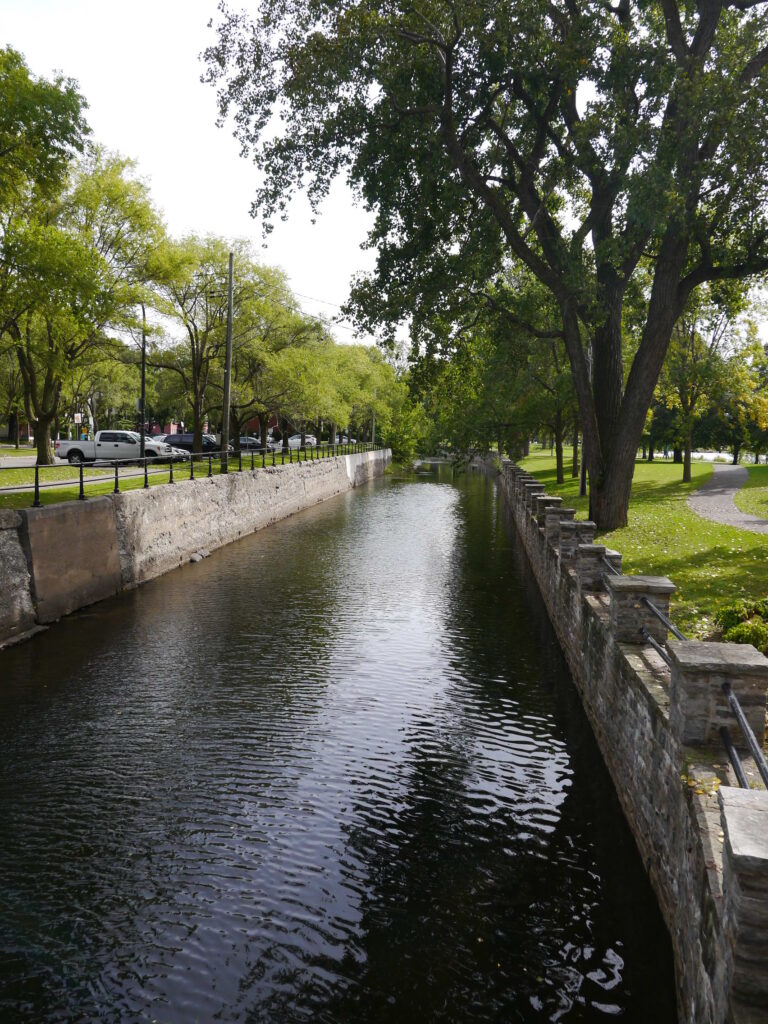
Lachine Canal, JH photo
Phineas ran into serious financial difficulties and lost his farm to pay off his debts. The family left for Canada around 1795 and settled in LaPrairie, on the south shore of the St. Lawrence River near Montreal, and Phineas became an innkeeper. Lucie Bagg (1798-1874), Stanley’s half-sister, was born in LaPrairie.
When Stanley was a young man in 1810, he and his father rented a house from butcher John Clark (1767-1827) on St. Lawrence Street about a mile north of Sherbrooke Street, and opened a tavern. The Mile End Tavern was located at the point where the only two roads in the area crossed, and Stanley probably met many people there.
Exciting business opportunities came his way. For starters, he and business partner Oliver Wait got a lucrative contract to transport six cannons from Montreal to Kingston during the War of 1812. The subcontractors to whom they gave the job delivered the cannons safely. In 1819, the pair landed a contract to level Montreal’s Citadel Hill, where the army stored its arms and ammunition. Along with two more partners, Andrew White and Thomas Phillips, they then won contracts to provide building materials for two new forts outside the city walls, one on Île Ste. Hélène, the other on the Richelieu River, near the American border.
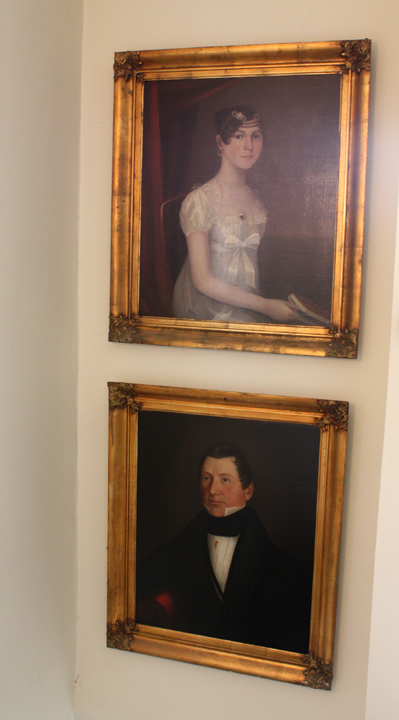
Stanley and Mary Ann Bagg
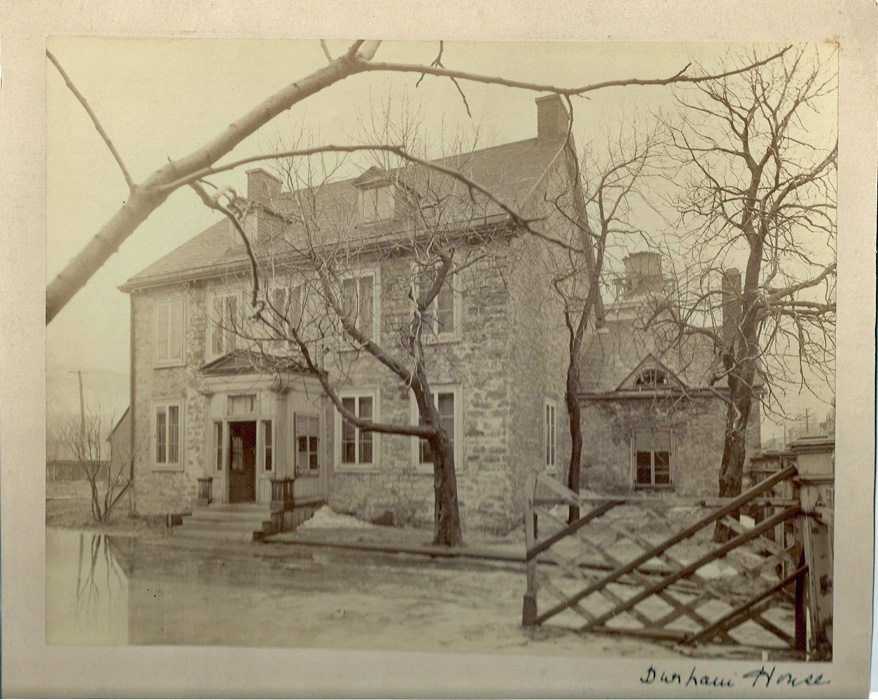
Stanley became a family man. He married John Clark’s daughter, Mary Ann (1795-1835), on Aug. 7, 1819.3 As a wedding present, Clark gave the couple a house on St. Lawrence Street, just north of Sherbrooke Street, in an area known as Côte à Baron (sometimes spelled Côteau Barron). It was named Durham House, after the Clark family’s native Durham, England. The couple’s only child, Stanley Clark Bagg, was born there on Dec. 23, 1820.4
In 1821, Bagg, Wait, White and Phillips won a huge contract to construct the Lachine Canal. The project, designed to allow boats to bypass rapids in the St. Lawrence River, involved excavating the 14-kilometer canal and building six stone locks and several bridges. It took four years to complete and employed thousands of mostly Irish immigrant labourers. Stanley was the project’s treasurer.
After the Lachine Canal was finished, Stanley became what we would consider a small businessman. In contemporary documents he was usually called a “trader.” He was always on the lookout for promising deals, however, the economic climate in Lower Canada was difficult as it depended on decisions made in England. Cash was always in short supply and the colony’s banking system was rudimentary, but the timber trade was thriving. Collaborating with various partners and sub-contractors, Stanley invested in steamboats, traded dry goods and harvested timber.5
He collaborated with his brother Abner to import flour from Upper Canada and he sold beef to the army in partnership with butcher John Clark. He and his friend Matthew Campbell went into business together as general merchants. But it was always a scramble, and in many of the letters he wrote in the mid-1830s, he complained to customers who were late paying their bills.
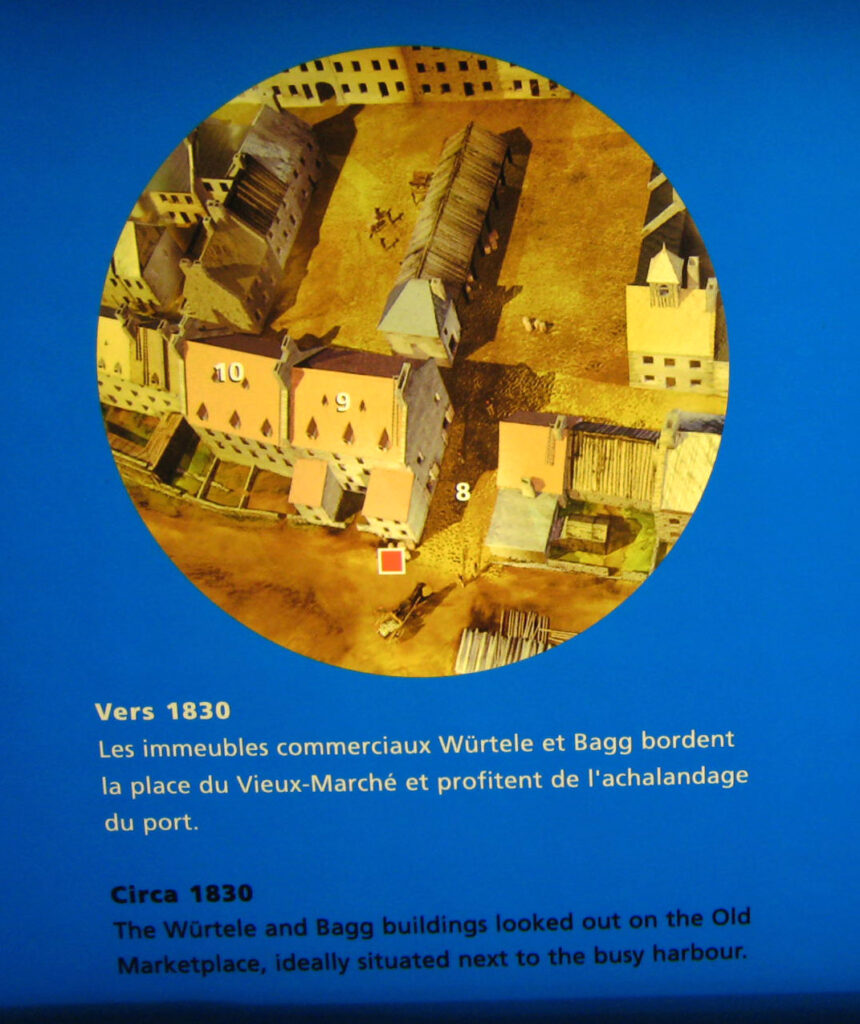
From a display at the Pointe-à-Callière Montreal Archaeology and History Museum. The Bagg building was no 10.
Throughout the 1820s and 1830s, he was especially active as a timber merchant. He contracted to buy timber from logging shanties in several locations, but especially in the Chateauguay River valley, southwest of Montreal. He sold the large squared pine timbers for shipment to England, where they were used in shipbuilding or for construction projects closer to home, and he sold the small logs to the army and to local residents for firewood. In a letter to a client dated April 27, 1835, he wrote, “I have always been apprehensive of danger on small streams in my timber operations, and with much pleasure have to inform you that my timber made on the River Chateauguay got safely down to the basin some time ago and I expect a part of it in here tomorrow, which I will forward on to Quebec as soon as the state of the navigation will allow.” 6
Stanley never owned a great deal of land at any one time, but he tried to profit by buying and selling real estate, or by renting out properties to tenants. These properties were all over the city and surrounding region. One commercial building that people still associate with his name was located near the market square in Montreal’s Old Port. Today, its foundations can be seen in the underground level of the Pointe-à-Callière Montreal Archaeology and History Museum. Another building that Montreal historians have associated with Stanley and Abner Bagg is now the Outremont City Hall. They owned it from 1814 to 1829, when it was an ordinary house.7
As executor of his father-in-law’s estate, Stanley collected the rental income from several large farms on the west side of St. Lawrence Street, from Sherbrooke Street to the Rivière des Prairies. John Clark had left these properties to his daughter and to his seven-year-old grandson. When Mary Ann died in 1835, Stanley became executor of her estate also, overseeing these investments and buying and selling adjacent lots until Stanley Clark Bagg reached 21 years of age.
Stanley was probably very familiar with farming methods. Mile End, where the tavern had been, was a working farm, and Durham House had an orchard, beehives, a dovecot and several pigs, cows and horses. Stanley especially enjoyed riding horses and owned many throughout his life. He even opened a race track near the Mile End Tavern. Meanwhile, although Stanley was a moderately successful businessman, his financial situation became complicated after Abner’s hat manufacturing business went bankrupt in 1827. Stanley tried to help his brother pay back some of his debts and, through various legal manoeuvers, hold on to a small income stream from property rentals. Abner never fully recovered from this crisis and still owned money to Stanley and to other creditors when both brothers died in the early 1850s.
Durham House, private collection
In 1832, as a well-liked member of the English-speaking business community, Stanley ran in a by-election for a seat in Lower Canada’s Legislative Assembly. His opponent was Irish physician Daniel Tracey. The voting continued for several weeks and was marred by violence throughout. After the British troops opened fire on a crowd near the polling station, killing three innocent bystanders, Stanley withdrew his name from the ballot. According to a family story, he was devastated by these events. He never ran for elected office again, although he did serve as an appointed councillor on the 1840-1842 Montreal City Council. He was active in the community in other ways. In 1841, he was listed as a founding shareholder in the City Bank and, four years later, he was one of 400 people named Justice of the Peace for the District of Montreal.8
During the Rebellions of 1837-38, Stanley did what he no doubt saw as his duty to help protect Lower Canada. He was a major in the 1st Battalion Loyal Volunteers during that conflict, and Durham House served as a headquarters for militia officers. When he retired from the militia in 1852, he held the rank of Lieutenant Colonel.
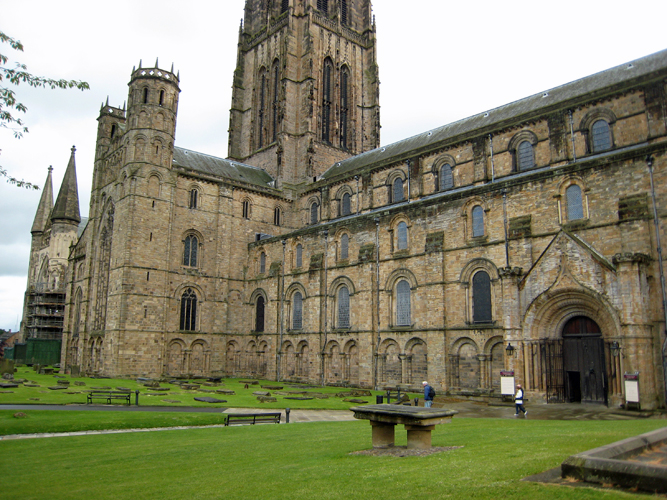
In 1842, Stanley took what must have been the trip of a lifetime: he and his son went to England. Stanley Clark had turned 21 and had completed his apprenticeship as a notary. Many years later, Stanley Clark recalled visiting Durham Cathedral on that trip when he wrote, “The first time I had the privilege of attending divine service in Durham Abbey, I was enraptured with the sweet and masterly chanting, unsurpassed in the empire. My father and I obtained seats in the choir.” 9
Durham Cathedral, JH photot
After they returned from abroad, Stanley began to turn over to Stanley Clark the property and income the young man had inherited from his grandfather and mother. At this point, Stanley admitted that, as executor, he had not kept track of the income and expenses of the estates, and that he had used 3,000 pounds “for his own profit and advantage”.10 He mortgaged several of his own properties to repay his son.
He also admitted that managing Durham House was a big responsibility, and he had not paid his servants’ wages for some time. He made an agreement with Stanley Clark to give him the house and sell him the furniture and other contents. In return, Stanley Clark promised to provide his father with clothing, food and care and to let him live at Durham House for the rest of his life.
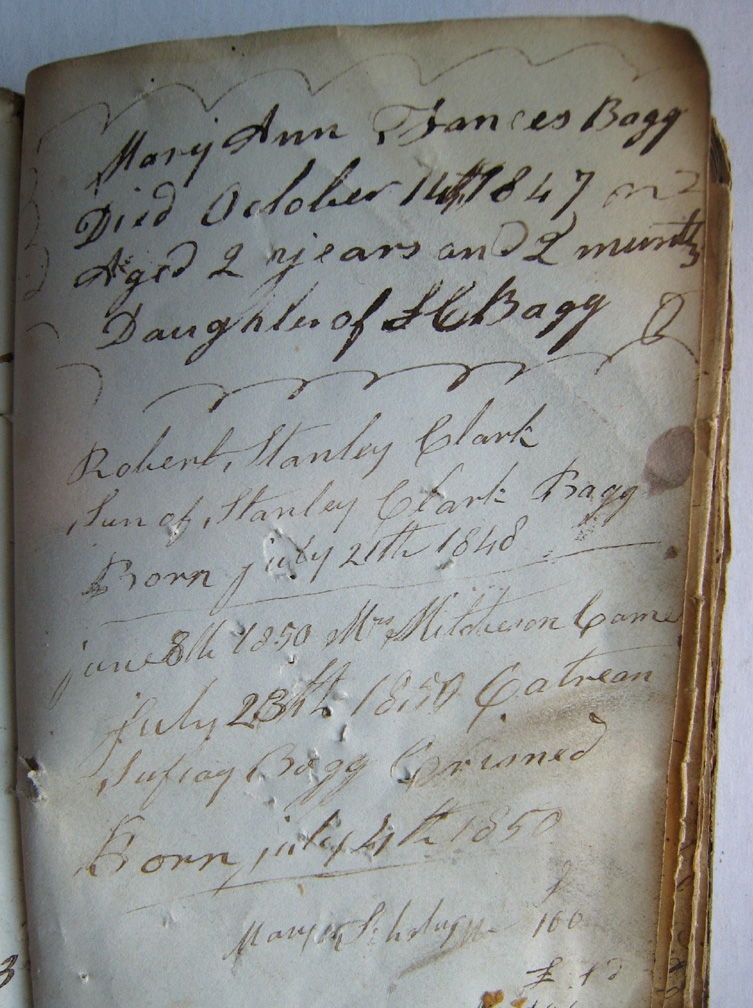
Stanley Clark Bagg married Catherine Mitcheson in Philadelphia on Sept. 4, 1844. I do not know whether Stanley attended the wedding. The young couple built a home of their own, Fairmount Villa, not far from Durham House, so Stanley probably had the opportunity to see his young grandchildren.
Stanley’s notebook at the McCord Museum
When Stanley signed his will on May 28, 1851, he had already sold his real estate or given it to Stanley Clark. He owned almost nothing. Most of the provisions of the will were designed to forgive Abner’s long-standing debts to Stanley, and to protect Stanley Clark from Abner’s remaining creditors. In his will, Stanley admitted that some of the transactions in which he had been engaged were of an “uncertain nature.”11
In the summer of 1852, father and son had a notary make out one final agreement between them.12 It appears that Stanley was now so ill he needed a medical attendant, but Stanley Clark may have been surprised by the bills. In this agreement, Stanley was able to spend up to 25 pounds a year to hire someone to look after him.
Stanley died on Oct. 31, 1853.13 His remains were buried in the Protestant cemetery in Montreal, but when that cemetery was closed, they were moved to the Bagg family crypt at Mount Royal Cemetery. As he requested in his will, he was buried with his wife and his father.
In the last two years of his life, Stanley claimed to be sound of mind but sick in body. Indeed, he seemed but a shadow of the ambitious young merchant he had once been. He was probably in pain, perhaps depressed and lonely. Hopefully he would have been consoled to know that his accomplishments, his trials, his failures and his honesty are remembered almost 200 years later.
John Bagg, Stanley’s great-great-grandfather, married Hannah Burt in Springfield, MA in 1657. Henry M. Burt, The First Century of the History of Springfield. The Official Records from 1636 to 1736, with an Historical Review and Biographical Mention of the Founders. Volume II. Springfield, Mass: printed and published by Henry M. Burt, 1899. p. 524.
Stanley and his brother Abner were both baptized as adults in Christ Church (Anglican) Montreal and his date of birth was recorded at this time. “Quebec, Canada, Vital and Church Records (Drouin Collection), 1621-1968” [database on-line]. Ancestry.com, (www.ancestry.ca, accessed 2 Oct. 2016), entry for Stanley Bagg, 2 April, 1831; citing Gabriel Drouin, comp. Drouin Collection. Montreal, Quebec, Canada: Institut Généalogique Drouin.
“Quebec, Canada, Vital and Church Records (Drouin Collection), 1621-1968” [database on-line]. Ancestry.com, (www.ancestry.ca, accessed 30 Sept. 2016), entry for Stanley Bagg, 7 Aug. 1819; citing Gabriel Drouin, comp. Drouin Collection. Montreal, Quebec, Canada: Institut Généalogique Drouin.
“Quebec, Canada, Vital and Church Records (Drouin Collection), 1621-1968” [database on-line]. Ancestry.com, (www.ancestry.ca, accessed 30 Sept. 2016), entry for Stanley Clark Bagg, 2 July 1822; citing Gabriel Drouin, comp. Drouin Collection. Montreal, Quebec, Canada: Institut Généalogique Drouin.
A variety of sources provide background on Stanley Bagg’s business activities. Notarial records of business agreements, especially wood contracts and leases, are the most important and can be found on microfilm and online at the Bibliothèque et Archives nationales du Québec (BAnQ) in Montreal. Among the notaries Stanley used frequently were H. Griffin (1812-1847), Joseph Desautels (1810-1821), N-B Doucet (1804-1855), A-T Kimber (1825-1832), T. Bedouin (1812-1844), J-H Jobin (1833-1881), W.N. Crawford (1826-1850), G.D. Arnoldi (1827-1836) and John H. Isaacson. The Canada Gazette and newspaper articles also provide records of his activities. The Bagg Family Fonds at the McCord Museum in Montreal holds a number of records, especially pertaining to the construction of the Lachine Canal (P070/A3), as well as copies of Stanley’s business letters (P070/B2.3) and other business documents (P070/A5.2).
Stanley Bagg, letterbook, Bagg Family Fonds, P070/B2.3. McCord Museum
N.B. Doucet (CN601,S134), no. 16251, 8 June 1829, BAnQ
Stanley Clark Bagg, “The Antiquities and Legends of Durham; a Lecture before the Numismatic & Antiquarian Society of Montreal”, Montreal: Daniel Rose, 1866.