Tag: Phineas Bagg

Mile End Farm: the Origins of a Neighbourhood

with additional research by Justin Bur

The Mile End neighbourhood of Montreal is famous as the home of Montreal bagels and of novelist Mordecai Richler. Its iconic architecture features outside staircases attached to two- and three-storey rowhouses, next door to churches, synagogues, shops, cafés and renovated manufacturing buildings. But Mile End’s history goes back to one small tavern at a crossroads in the countryside more than 200 years ago.

The Mile End Tavern was located at today’s northwest corner of Saint Laurent Boulevard and Mount Royal Avenue,1 now the starting point of the Mile End neighbourhood. In turn, Mile End is on the Plateau, an elevated plain lying north of Sherbrooke Street and east of Mount Royal.

The first known reference to Mile End was dated April 21, 1808, when landowner John Clark placed a notice in the Gazette advertising Mile End Farm as providing “good pasture for horses and cows at the head of the Faubourg [suburb] Saint-Laurent.”

Clark (1767-1827), an English-born butcher, acquired the land he would call Mile End Farm in several transactions, including purchase agreements and leases, between 1804 and 1810.2 Like most farms in Quebec, it was long and narrow. At its greatest extent in 1810, it measured 2.5 kilometers from south to north, and between 400 and 550 meters wide. Clark was almost certainly the one who chose the name Mile End. The centre of his property was about a mile north of the small city of Montreal, and the area might have reminded him of another Mile End, a mile east of London, England. The name caught on and has been in use ever since.

John Clark. Private collection.

When Montreal was founded in 1642, Mile End was probably uninhabited. The ground was too rocky for settlements or agriculture, and few Indigenous artefacts have been found there. The northeastern region of the Island of Montreal was covered by a vast cedar forest. The heart of Mile End was also forested, but there, both cedar and ash trees were the dominant species. This forest was still intact when the Sulpician priests mapped the area in 1702, but as the city’s population grew — it stood at around 1,200 residents in 1700 – more and more trees were cut to provide firewood.   

By 1780, most trees had disappeared from the foot of the mountain, replaced by houses, farm buildings, hay fields and pastures. In the Mile End area, livestock pastures, vegetable crops, tanneries and quarries dominated the countryside, and orchards were planted in the mid-1800s.

In 1663, the Sulpician priests became the seigneurs, or feudal lords, of the entire island. In 1701, the Hôpital Général acquired an extensive piece of land from the Sulpicians in the future Mile End area, and the Grey Nuns took over the hospital and all its lands in 1747. In 1803, the nuns sold the piece of land that would become Mile End Farm to two masons, Jean-Baptiste Boutonne and Joseph Chevalier. They wanted to quarry its stone and sand for building materials.

The masons had to pay the Grey Nuns a rente constituée (annual interest), as well as yearly seigneurial dues to the Sulpicians. So when John Clark bought the property – the first part of his Mile End Farm — in 18044 and gave Boutonne and Chevalier the right to continue collecting building materials for seven years after the sale, they must have been relieved. Meanwhile, Clark found another use for the land, first advertising pasture for other peoples’ cows in 1808.

When the same ad for livestock pasturing at Mile End Farm appeared the following year, it was placed by Phineas Bagg (c.1751-1823) and his son Stanley Bagg (1788-1853), my four-times and three-times great-grandfathers. A farmer from western Massachusetts, Phineas had brought his family to Canada around 1795. Initially he worked as an innkeeper in LaPrairie, near Montreal, and then the family moved onto the island.

In 1810, Phineas and Stanley signed a lease with John Clark.5 Paying an annual rent of 112 pounds, 10 shillings, they ran the Mile End Tavern and managed the farm for the next seven years before subletting to another innkeeper.

see caption below.

The lease described the property as having a two-storey house (which at some point must have been converted into the tavern), a barn, stable and outbuildings. The Baggs were required to sufficiently manure the pastures and arable land, to cultivate and to perform road maintenance and other required duties. They were permitted to cut wood for fencing and firewood, but they had to preserve the maple grove. They were also permitted to cut and remove stone.

No doubt the tavern brought them a good income since it was located at an important, if somewhat remote, intersection. Stanley must have attracted many additional customers after he built a racetrack nearby. In May 1811, he signed an agreement with the Jockey Club of Montreal, subletting a piece of land to the club and promising to build the track within five weeks. The club supervised the races. The track, partially on land leased from the Sisters of the Hôtel-Dieu, was about a mile in circumference and what is now Jeanne Mance Park, extending east to Saint-Laurent. It was most likely the first racetrack in Montreal.6

Another reference to Mile End appeared in the Gazette on August 4, 1815 when Stanley Bagg, Mile End Tavern, placed a notice offering a reward for information about a lost bay horse, about 10 years old, with a white face and some white about the feet.7

In 1819, Stanley married John Clark’s daughter, Mary Ann (John Clark was also my four-times great-grandfather). Their son, Stanley Clark Bagg (1820-1873), eventually inherited the Mile End Farm, as well as other properties Clark had owned nearby.

In the second half of the 19th century, Stanley Clark Bagg began subdividing and selling the properties he had inherited from his father and grandfather. He died in 1873 and the next generation of the family continued to sell building lots from the Stanley Clark Bagg Estate.

In 1891, they sold most of the Mile End Farm property to McCuaig and Mainwaring, a pair of promoters from Toronto who envisioned a high-end residential suburb they called Montreal Annex.8 The project got off to a slow start because basic services such as water, sewers and streetlights were nonexistent and a promised electric tramway did not materialize in time. A recession that started in 1893 put an end to their dreams. A few years later another group of investors, the Montreal Investment & Freehold Company, took over the property and the area developed as a mixture of duplexes, triplexes and commercial buildings.

Meanwhile, the Mile End Hotel continued to appear in city directories at the corner of Saint- Laurent and Mount Royal until 1900. The property was expropriated for road widening in 1902 and the building was demolished. A department store had replaced it by 1906.

Caption for Map The areas with a greyish tinge are the areas that John Clark held by lease rather than owning them; none of them ever came back to Clark-Bagg possession after the leases ended. The yellow areas are cutouts belonging to and reserved by other people, excluded from the rectangles describing the property leased to P & S Bagg in 1810. Mile End Farm was bounded by the modern Saint-Laurent Blvd. in the east, while the future Park Avenue was just to the west and Pine Ave. would have been the southern boundary. RHSJ refers to the Religieuses Hospitalières de Saint-Joseph de Montréal, a religious order dedicated to caring for the sick.

This article also appears in my collaborative family history blog, https://genealogyensemble.com

See also:

Janice Hamilton, John Clark, 19th Century Real-Estate Visionary, Writing Up the Ancestors, May 22, 2019, https://www.writinguptheancestors.ca/2019/05/john-clark-19th-century-real-estate.html

Janice Hamilton, The Life and Times of Phineas Bagg, Writing Up the Ancestors, Oct. 17, 2018, https://www.writinguptheancestors.ca/2018/10/the-life-and-times-of-phineas-bagg.html

Janice Hamilton, The Life and Times of Stanley Bagg (1788-1853), Writing Up the Ancestors, Oct. 5, 2016, https://www.writinguptheancestors.ca/2016/10/the-life-and-times-of-stanley-bagg-1788.html

Notes and Sources

1.  Mount Royal Avenue is the continuation of Côte Sainte-Catherine Road, which traverses the northeast slope of Mount Royal and continues east of Saint-Laurent Boulevard. Saint- Laurent, now a busy commercial street, was at one time the only road leading north from city to the Rivière des Prairies, on the north shore of Montreal Island. Built by the Sulpician priests in 1717, Saint Laurent was initially known as Le grand chemin du Roy – the Great King’s Highway. Over the years it has been known by many names, English and French, including Chemin Saint-Laurent, St. Lawrence Street and “the Main”. Since 1905, its official name has been Boulevard Saint-Laurent.

2.  Yves Desjardins, Histoire du Mile End, Québec: Les Ēditions du Septentrion, 2017, p.  22.

3.  Island of Montreal property owners were required to pay dues to the Sulpicians every year until the seigneurial system was gradually abolished there, starting in 1840. The system was abolished in the rest of Quebec in a gradual process starting in 1854.

4.       Louis Chaboillez, n.p. no 6090, 30 May 1804. A reference to the purchase also appears in J.A. Labadie, n.p. no 16733, 7 June 1875. This was the inventory of Stanley Clark Bagg’s Estate. It includes the name of the seller, the date of the sale and the notary who prepared the deed. This part of Mile End Farm is item #264.

5.  Jonathan A. Gray, n.p. no 2874, 17 Oct. 1810.

6.  Justin Bur, Yves Desjardins, Jean-Claude Robert, Bernard Vallée, Joshua Wolfe, Dictionnaire historique du Plateau Mont-Royal (Montreal, Éditions Écosociété, 2017), p 107.

7.  Justin Bur, “À la recherche du cheval perdu de Stanley Bagg, et des origines du Mile End.” A la recherche du savoir: nouveaux échanges sur les collections du Musée McCord; Collecting Knowledge: New Dialogues on McCord Museum Collections. Joanne Burgess, Cynthia Cooper, Celine Widmer, Natasha Zwarich. Montreal: Éditions MultiMondes, 2015, p. 143.

8.  Justin Bur, Yves Desjardins, Jean-Claude Robert, Bernard Vallée, Joshua Wolfe, Dictionnaire historique du Plateau Mont-Royal (Montreal, Éditions Écosociété, 2017), p 271.
The Life and Times of Stanley Bagg, 1788-1853

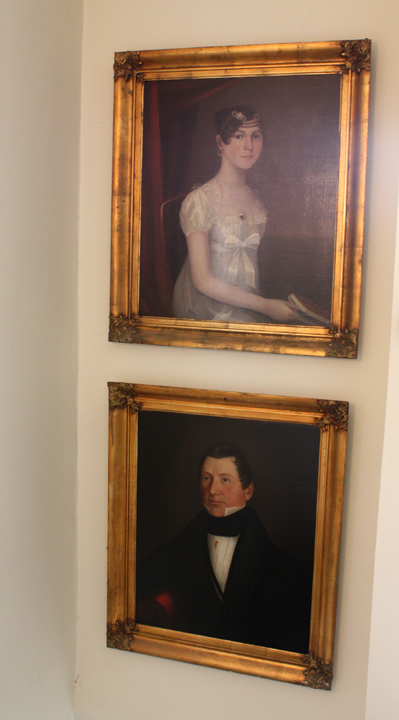
My three-times great-grandfather Stanley Bagg’s claim to minor historical fame is that he was the English party candidate in the 1832 by-election in Montreal that ended in the deaths of three innocent bystanders who were shot by the British army. Because that incident was one of the factors that led to the outbreak of a violent rebellion in Lower Canada five years later, Stanley’s name has appeared in numerous books about Quebec history.  

Stanley’s foray into politics only lasted about a month. For most of his life, he worked as a merchant and, as far as I can tell, he was just a hard-working individual who did not seek the spotlight. As a result, none of the historians who have mentioned his name have known much about him, or worse, what they have published is incorrect. Now, it is encouraging to see that recent research into his life and times is becoming publicly available. This fall, Stanley’s portrait, along with a brief accurate biography, appeared in Quebec’s new grade 10 history textbook.

There are several articles on this blog that detail various aspects of Stanley’s life (see the links below). Here, for the record, is an overview of his life:  

The most common error about Stanley Bagg is that his family immigrated to Canada from England in the late 18th century. In fact, the Bagg family had lived in western Massachusetts since the mid-1600s.1 Stanley was born on June 27, 17882 in Pittsfield, MA, where his father, Phineas Bagg (c. 1750-1823) was a farmer. His mother, Pamela Stanley (1760 – c. 1793), died, leaving Phineas with four young children: Polly (1785-1856), Stanley (1788-1853), Abner (c. 1790-1852) and Sophia (c. 1791-1860).

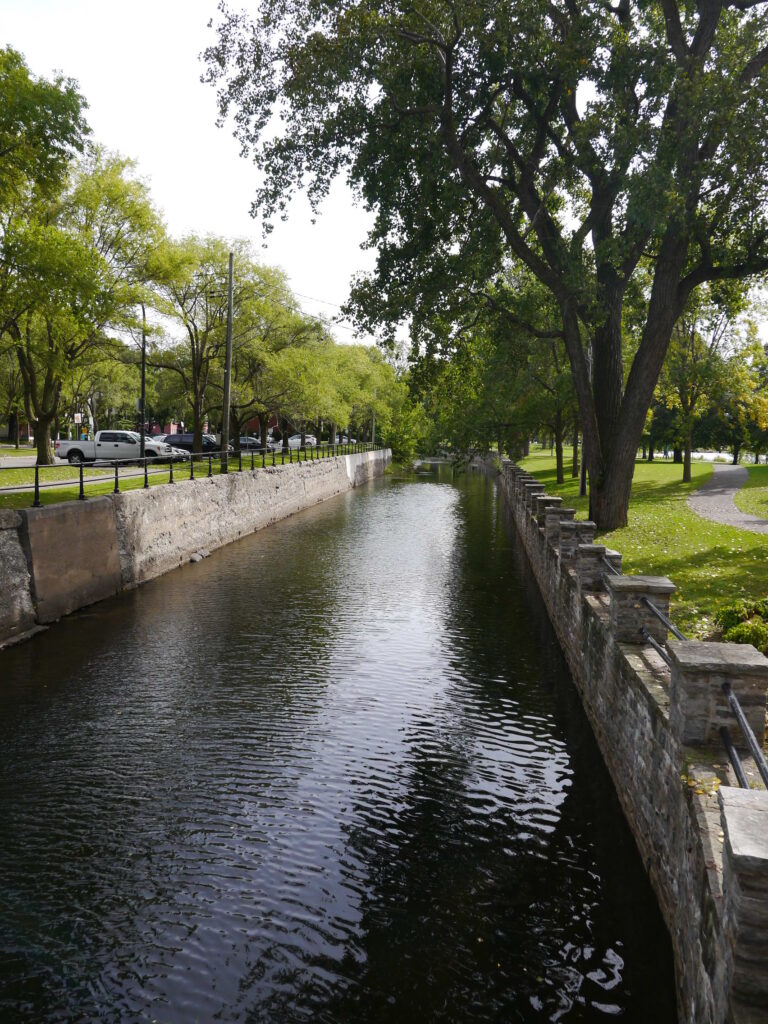
Lachine Canal, JH photo

Phineas ran into serious financial difficulties and lost his farm to pay off his debts. The family left for Canada around 1795 and settled in LaPrairie, on the south shore of the St. Lawrence River near Montreal, and Phineas became an innkeeper. Lucie Bagg (1798-1874), Stanley’s half-sister, was born in LaPrairie.  

When Stanley was a young man in 1810, he and his father rented a house from butcher John Clark (1767-1827) on St. Lawrence Street about a mile north of Sherbrooke Street, and opened a tavern. The Mile End Tavern was located at the point where the only two roads in the area crossed, and Stanley probably met many people there. 

Exciting business opportunities came his way. For starters, he and business partner Oliver Wait got a lucrative contract to transport six cannons from Montreal to Kingston during the War of 1812. The subcontractors to whom they gave the job delivered the cannons safely. In 1819, the pair landed a contract to level Montreal’s Citadel Hill, where the army stored its arms and ammunition. Along with two more partners, Andrew White and Thomas Phillips, they then won contracts to provide building materials for two new forts outside the city walls, one on Île Ste. Hélène, the other on the Richelieu River, near the American border. 

Stanley and Mary Ann Bagg

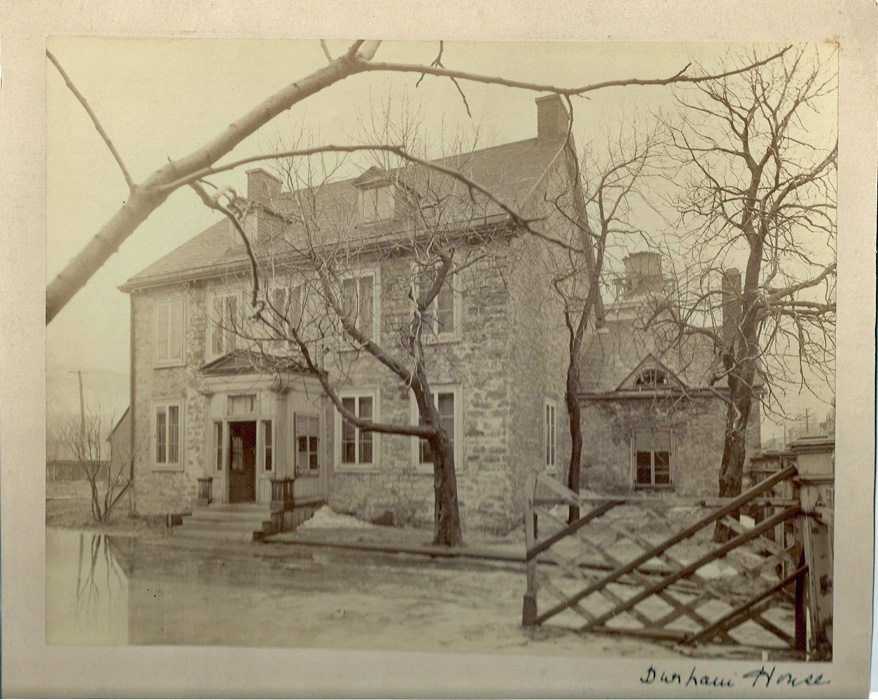
 Stanley became a family man. He married John Clark’s daughter, Mary Ann (1795-1835), on Aug. 7, 1819.3 As a wedding present, Clark gave the couple a house on St. Lawrence Street, just north of Sherbrooke Street, in an area known as Côte à Baron (sometimes spelled Côteau Barron). It was named Durham House, after the Clark family’s native Durham, England. The couple’s only child, Stanley Clark Bagg, was born there on Dec. 23, 1820.4

In 1821, Bagg, Wait, White and Phillips won a huge contract to construct the Lachine Canal. The project, designed to allow boats to bypass rapids in the St. Lawrence River, involved excavating the 14-kilometer canal and building six stone locks and several bridges. It took four years to complete and employed thousands of mostly Irish immigrant labourers. Stanley was the project’s treasurer. 

After the Lachine Canal was finished, Stanley became what we would consider a small businessman. In contemporary documents he was usually called a “trader.” He was always on the lookout for promising deals, however, the economic climate in Lower Canada was difficult as it depended on decisions made in England. Cash was always in short supply and the colony’s banking system was rudimentary, but the timber trade was thriving. Collaborating with various partners and sub-contractors, Stanley invested in steamboats, traded dry goods and harvested timber.5

He collaborated with his brother Abner to import flour from Upper Canada and he sold beef to the army in partnership with butcher John Clark. He and his friend Matthew Campbell went into business together as general merchants. But it was always a scramble, and in many of the letters he wrote in the mid-1830s, he complained to customers who were late paying their bills.

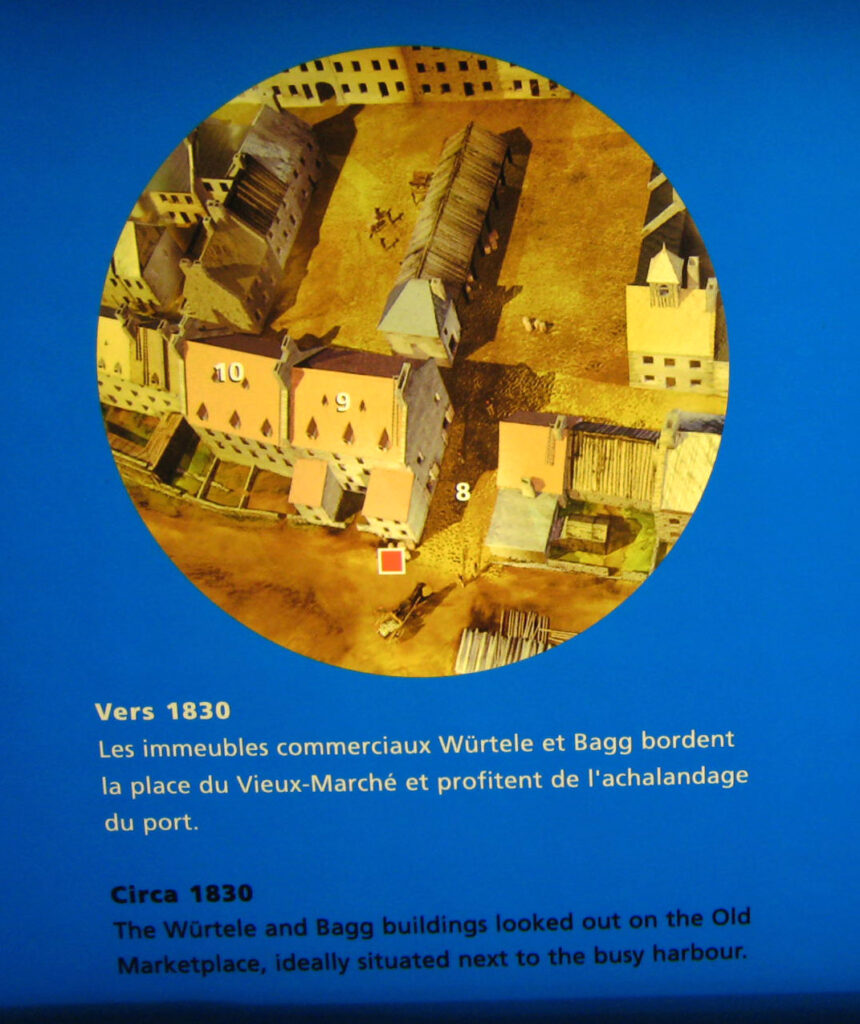
From a display at the Pointe-à-Callière Montreal Archaeology and History Museum. The Bagg building was no 10.

Throughout the 1820s and 1830s, he was especially active as a timber merchant. He contracted to buy timber from logging shanties in several locations, but especially in the Chateauguay River valley, southwest of Montreal. He sold the large squared pine timbers for shipment to England, where they were used in shipbuilding or for construction projects closer to home, and he sold the small logs to the army and to local residents for firewood. In a letter to a client dated April 27, 1835, he wrote, “I have always been apprehensive of danger on small streams in my timber operations, and with much pleasure have to inform you that my timber made on the River Chateauguay got safely down to the basin some time ago and I expect a part of it in here tomorrow, which I will forward on to Quebec as soon as the state of the navigation will allow.” 6

Stanley never owned a great deal of land at any one time, but he tried to profit by buying and selling real estate, or by renting out properties to tenants. These properties were all over the city and surrounding region. One commercial building that people still associate with his name was located near the market square in Montreal’s Old Port. Today, its foundations can be seen in the underground level of the Pointe-à-Callière Montreal Archaeology and History Museum. Another building that Montreal historians have associated with Stanley and Abner Bagg is now the Outremont City Hall. They owned it from 1814 to 1829, when it was an ordinary house.7

As executor of his father-in-law’s estate, Stanley collected the rental income from several large farms on the west side of St. Lawrence Street, from Sherbrooke Street to the Rivière des Prairies. John Clark had left these properties to his daughter and to his seven-year-old grandson. When Mary Ann died in 1835, Stanley became executor of her estate also, overseeing these investments and buying and selling adjacent lots until Stanley Clark Bagg reached 21 years of age.  

Stanley was probably very familiar with farming methods. Mile End, where the tavern had been, was a working farm, and Durham House had an orchard, beehives, a dovecot and several pigs, cows and horses. Stanley especially enjoyed riding horses and owned many throughout his life. He even opened a race track near the Mile End Tavern.  Meanwhile, although Stanley was a moderately successful businessman, his financial situation became complicated after Abner’s hat manufacturing business went bankrupt in 1827. Stanley tried to help his brother pay back some of his debts and, through various legal manoeuvers, hold on to a small income stream from property rentals. Abner never fully recovered from this crisis and still owned money to Stanley and to other creditors when both brothers died in the early 1850s.  

Durham House, private collection

In 1832, as a well-liked member of the English-speaking business community, Stanley ran in a by-election for a seat in Lower Canada’s Legislative Assembly. His opponent was Irish physician Daniel Tracey. The voting continued for several weeks and was marred by violence throughout. After the British troops opened fire on a crowd near the polling station, killing three innocent bystanders, Stanley withdrew his name from the ballot. According to a family story, he was devastated by these events. He never ran for elected office again, although he did serve as an appointed councillor on the 1840-1842 Montreal City Council.  He was active in the community in other ways. In 1841, he was listed as a founding shareholder in the City Bank and, four years later, he was one of 400 people named Justice of the Peace for the District of Montreal.8

During the Rebellions of 1837-38, Stanley did what he no doubt saw as his duty to help protect Lower Canada. He was a major in the 1st Battalion Loyal Volunteers during that conflict, and Durham House served as a headquarters for militia officers. When he retired from the militia in 1852, he held the rank of Lieutenant Colonel. 

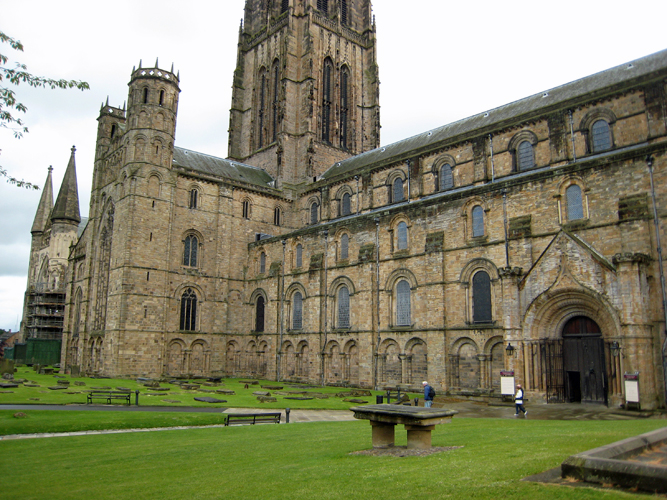
In 1842, Stanley took what must have been the trip of a lifetime: he and his son went to England. Stanley Clark had turned 21 and had completed his apprenticeship as a notary. Many years later, Stanley Clark recalled visiting Durham Cathedral on that trip when he wrote, “The first time I had the privilege of attending divine service in Durham Abbey, I was enraptured with the sweet and masterly chanting, unsurpassed in the empire. My father and I obtained seats in the choir.” 9

Durham Cathedral, JH photot

After they returned from abroad, Stanley began to turn over to Stanley Clark the property and income the young man had inherited from his grandfather and mother. At this point, Stanley admitted that, as executor, he had not kept track of the income and expenses of the estates, and that he had used 3,000 pounds “for his own profit and advantage”.10 He mortgaged several of his own properties to repay his son. 

He also admitted that managing Durham House was a big responsibility, and he had not paid his servants’ wages for some time. He made an agreement with Stanley Clark to give him the house and sell him the furniture and other contents. In return, Stanley Clark promised to provide his father with clothing, food and care and to let him live at Durham House for the rest of his life.

Stanley Clark Bagg married Catherine Mitcheson in Philadelphia on Sept. 4, 1844. I do not know whether Stanley attended the wedding. The young couple built a home of their own, Fairmount Villa, not far from Durham House, so Stanley probably had the opportunity to see his young grandchildren.

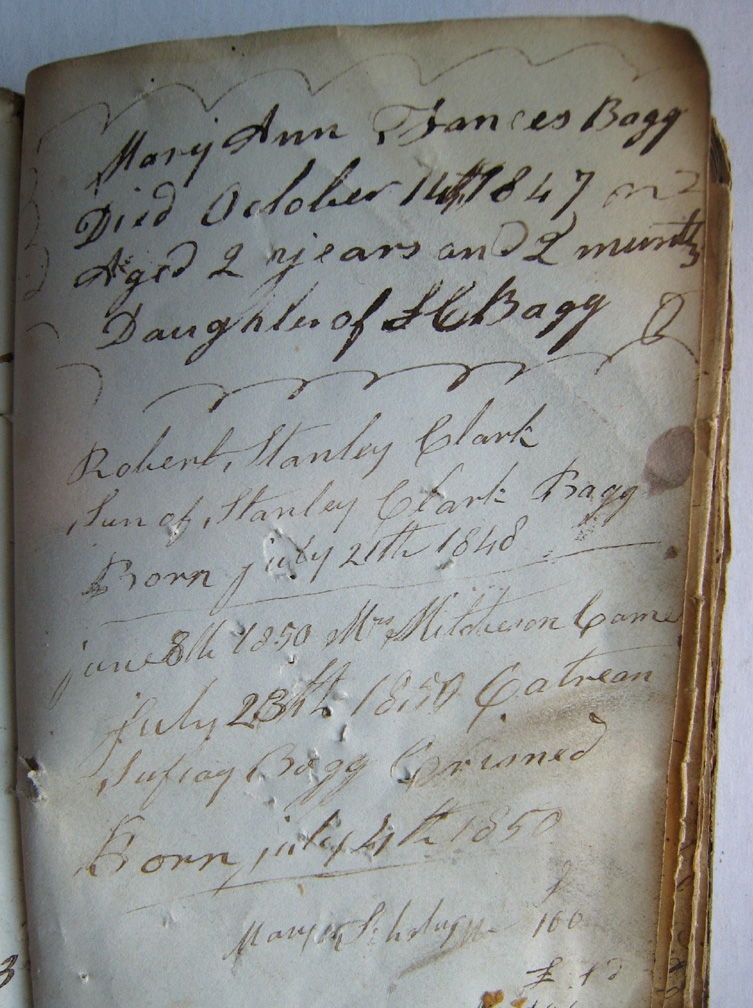
Stanley’s notebook at the McCord Museum

When Stanley signed his will on May 28, 1851, he had already sold his real estate or given it to Stanley Clark. He owned almost nothing. Most of the provisions of the will were designed to forgive Abner’s long-standing debts to Stanley, and to protect Stanley Clark from Abner’s remaining creditors. In his will, Stanley admitted that some of the transactions in which he had been engaged were of an “uncertain nature.”11

In the summer of 1852, father and son had a notary make out one final agreement between them.12 It appears that Stanley was now so ill he needed a medical attendant, but Stanley Clark may have been surprised by the bills. In this agreement, Stanley was able to spend up to 25 pounds a year to hire someone to look after him.  

Stanley died on Oct. 31, 1853.13 His remains were buried in the Protestant cemetery in Montreal, but when that cemetery was closed, they were moved to the Bagg family crypt at Mount Royal Cemetery.  As he requested in his will, he was buried with his wife and his father. 

In the last two years of his life, Stanley claimed to be sound of mind but sick in body. Indeed, he seemed but a shadow of the ambitious young merchant he had once been. He was probably in pain, perhaps depressed and lonely. Hopefully he would have been consoled to know that his accomplishments, his trials, his failures and his honesty are remembered almost 200 years later.  

Related Articles

Janice Hamilton, “An Economic Emigrant,” Oct 16, 2013, https://www.writinguptheancestors.ca/2013/10/an-economic-emigrant.html

Janice Hamilton, “The Mile End Tavern,” Oct. 21, 2013,https://www.writinguptheancestors.ca/2013/10/the-mile-end-tavern.html

Janice Hamilton, “Mary Ann (Clark) Bagg,” Nov. 29, 2013, https://www.writinguptheancestors.ca/2013/11/mary-ann-clark-bagg.html

Janice Hamilton, “A Home Well Lived In,” Jan. 21, 2014, https://www.writinguptheancestors.ca/2014/01/a-home-well-lived-in.html

Janice Hamilton, “Stanley Bagg and the Lachine Canal.  Part 1: the Contract,” Feb. 27, 2015 https://www.writinguptheancestors.ca/2015/02/stanley-bagg-and-lachine-canal-part-1_27.html

Janice Hamilton, “Stanley Bagg and the Lachine Canal.  Part 2: Rocks and Water,” March 13, 2015. https://www.writinguptheancestors.ca/2015/03/stanley-bagg-and-lachine-canal-part-2.html

Janice Hamilton, “Stanley Bagg and the Lachine Canal. Part 3: Contractor to the British Army,” March 27, 2015, https://www.writinguptheancestors.ca/2015/03/contractor-to-british-army.html

Janice Hamilton, “Stanley Bagg and the Montreal West By-Election of 1832,” Sept. 16, 2016, https://www.writinguptheancestors.ca/2016/09/stanley-bagg-and-montreal-west-by.html

Janice Hamilton, “Stanley Bagg’s Difficulties,” Jan. 10, 2014, https://www.writinguptheancestors.ca/2014/01/stanley-baggs-difficulties.html

Janice Hamilton, “Who Was Phineas Bagg?” Oct. 11, 2014, https://www.writinguptheancestors.ca/2014/10/who-was-phineas-bagg.html

Janice Hamilton, “Abner Bagg: Black Sheep of the Family?” April 19, 2015, https://www.writinguptheancestors.ca/2015/04/abner-bagg-black-sheep-of-family.html

Janice Hamilton, “Polly Bagg Bush and Her Family,” April 28 2016, https://www.writinguptheancestors.ca/2016/04/polly-bagg-bush-and-her-family-part-1.html

Janice Hamilton, “Lucie Bagg: Her Story,” March 30, 2016, https://www.writinguptheancestors.ca/2016/03/lucie-bagg-her-story.html

Sources

  1. John Bagg, Stanley’s great-great-grandfather, married Hannah Burt in Springfield, MA in 1657.  Henry M. Burt, The First Century of the History of Springfield. The Official Records from 1636 to 1736, with an Historical Review and Biographical Mention of the Founders. Volume II. Springfield, Mass: printed and published by Henry M. Burt, 1899. p. 524.  
  2. Stanley and his brother Abner were both baptized as adults in Christ Church (Anglican) Montreal and his date of birth was recorded at this time. “Quebec, Canada, Vital and Church Records (Drouin Collection), 1621-1968” [database on-line].  Ancestry.com, (www.ancestry.ca, accessed 2 Oct. 2016), entry for Stanley Bagg, 2 April, 1831; citing Gabriel Drouin, comp. Drouin Collection. Montreal, Quebec, Canada: Institut Généalogique Drouin.
  3. “Quebec, Canada, Vital and Church Records (Drouin Collection), 1621-1968” [database on-line].  Ancestry.com, (www.ancestry.ca, accessed 30 Sept. 2016), entry for Stanley Bagg, 7 Aug. 1819; citing Gabriel Drouin, comp. Drouin Collection. Montreal, Quebec, Canada: Institut Généalogique Drouin.
  4.  “Quebec, Canada, Vital and Church Records (Drouin Collection), 1621-1968” [database on-line].  Ancestry.com, (www.ancestry.ca, accessed 30 Sept. 2016), entry for Stanley Clark Bagg, 2 July 1822; citing Gabriel Drouin, comp. Drouin Collection. Montreal, Quebec, Canada: Institut Généalogique Drouin.
  5. A variety of sources provide background on Stanley Bagg’s business activities. Notarial records of business agreements, especially wood contracts and leases, are the most important and can be found on microfilm and online at the Bibliothèque et Archives nationales du Québec (BAnQ) in Montreal.  Among the notaries Stanley used frequently were H. Griffin (1812-1847), Joseph Desautels (1810-1821), N-B Doucet (1804-1855), A-T Kimber (1825-1832), T. Bedouin (1812-1844), J-H Jobin (1833-1881), W.N. Crawford (1826-1850), G.D. Arnoldi (1827-1836) and John H. Isaacson. The Canada Gazette and newspaper articles also provide records of his activities. The Bagg Family Fonds at the McCord Museum in Montreal holds a number of records, especially pertaining to the construction of the Lachine Canal (P070/A3), as well as copies of Stanley’s business letters (P070/B2.3) and other business documents (P070/A5.2).
  6. Stanley Bagg, letterbook, Bagg Family Fonds, P070/B2.3. McCord Museum
  7. N.B. Doucet (CN601,S134), no. 16251, 8 June 1829, BAnQ
  8. Canada Gazette, 11 October, 1845, http://www.collectionscanada.gc.ca/databases/canada-gazette/093/001060-119.01-e.php?document_id_nbr=1873&image_id_nbr=2837&f=p&PHPSESSID=j1au0sblq8sejaol266jar2vp4
  9. Stanley Clark Bagg, “The Antiquities and Legends of Durham; a Lecture before the Numismatic & Antiquarian Society of Montreal”, Montreal: Daniel Rose, 1866.
  10. J-H Jobin (CN610,S216) no. 3537, 8 Oct. 1842; J-H Jobin (CN601.S216), no. 3556, 2 Nov. 1842; J-H Jobin (CN610,S216) no. 3556h, 2 Nov. 1842, BAnQ.
  11. John H. Isaacson, 469-1797, 20 May 1851.
  12. J-E-O Labadie (CN601,S220) no. 520, 5 June 1852, BAnQ 
  13. “Quebec, Canada, Vital and Church Records (Drouin Collection), 1621-1968” [database on-line].  Ancestry.com, (www.ancestry.ca, accessed 2 Oct. 2016), entry for Stanley Bagg, 3 Nov. 1853; citing Gabriel Drouin, comp. Drouin Collection. Montreal, Quebec, Canada: Institut Généalogique Drouin.