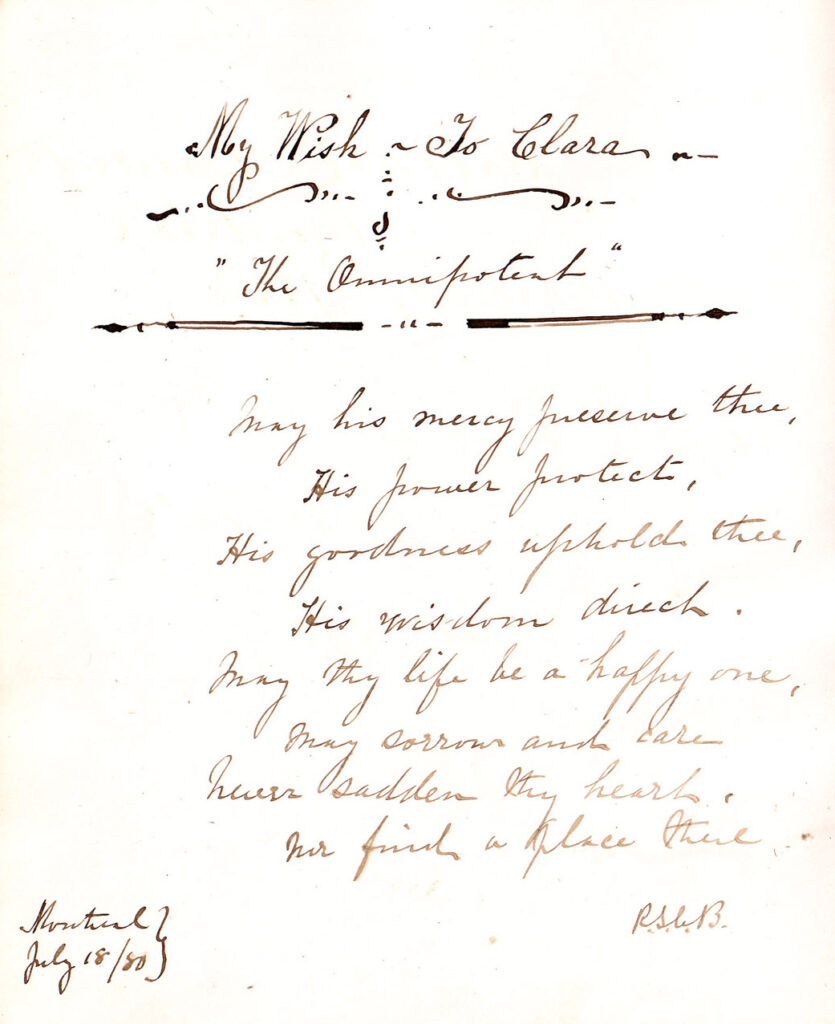
My mother never mentioned her great-aunt Helen, maybe because Helen lived in Vancouver, a continent away from the rest of the family in Montreal; or maybe because Helen and her husband moved there after he was involved in a scandal.
Helen Frances Mitcheson Bagg (1861-1935)1 was the youngest of Stanley Clark Bagg’s and Catherine Mitcheson’s five children. Her father was a wealthy land-owner in Montreal, and Helen grew up in a large house there called Fairmount Villa. She was educated in Canada, England and Europe and, according to her biography, she “excelled in English literature, especially poetry and composition.”2
Helen’s father died when she was 10 years old, and her only brother, Robert Stanley Bagg, took over the management of the family real estate business.3 Helen’s share of her father’s estate meant that, when she turned 21, she was a wealthy woman.4 She must have had an interest in business herself as, in 1890, she purchased a hotel from the estate.5
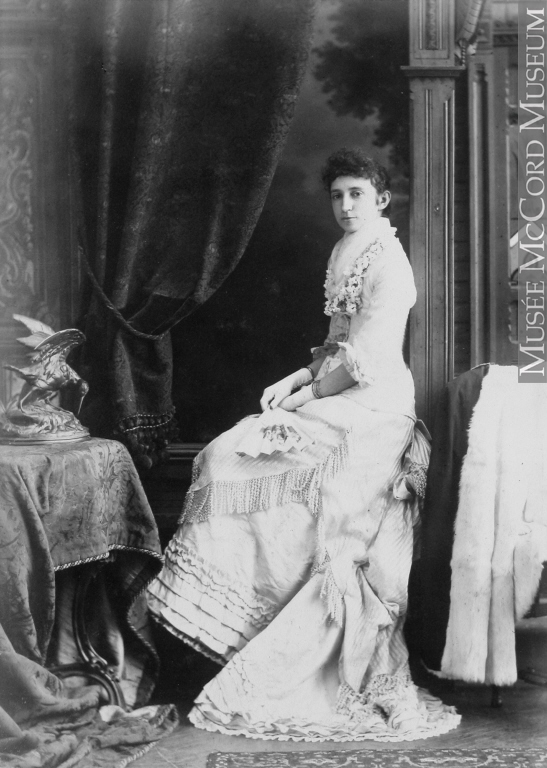
In 1891, Helen married real estate agent Albert Edward Lewis (1860-1908).6 One evening in 1898, he disappeared, and Montreal newspapers were filled with speculation about his fate.
La Patrie reported that Helen was afraid he had been assassinated.7A few days later, it became clear that he had left Montreal deliberately, and that he owed money to the Baggs.8 The laws of the time made it almost impossible for couples to divorce, so perhaps Helen decided to make the best of a difficult situation. Or perhaps she really loved him. For whatever reason, she set out to find him.
According to a Lewis family story,9 Helen, accompanied by a detective and perhaps a friend, went to the Far East to track him down. As her ship steamed into one port, she spotted Albert on the dock, awaiting the arrival of the mail from overseas.
Her biography mentioned that she spent several months in 1899 travelling in Siberia, the northern islands of Japan and remote parts of Korea, and that she wrote about these experiences for magazines such as the London Sphere, Wide World, and Canadian Magazine.10
The article added that she lived in Shanghai for a time, although it does not say whether she was there with Albert.11
According to the Lewis family, Helen “took Albert by the ear” and brought him back to Canada. The couple could not face returning to Montreal, so they settled in Vancouver,12 a port city that, two years earlier, had seen thousands of people pass through on their way north to the Klondike Gold Rush. Vancouver must have seemed pretty unsophisticated compared with Montreal, but a friend from Montreal, Julia Henshaw, lived there and probably helped Helen adjust.
Helen purchased a lot at 1960 Robson Street and hired an architect to build a house that she called Fairmount, after her childhood home. The couple quickly developed a social circle, and friends organized a party in honour of their 10th wedding anniversary.13 Albert worked as a real estate agent, Helen hosted croquet tournaments, they joined the tennis club and attended Christ Church, and no one appears to have known about Albert’s scandalous past.
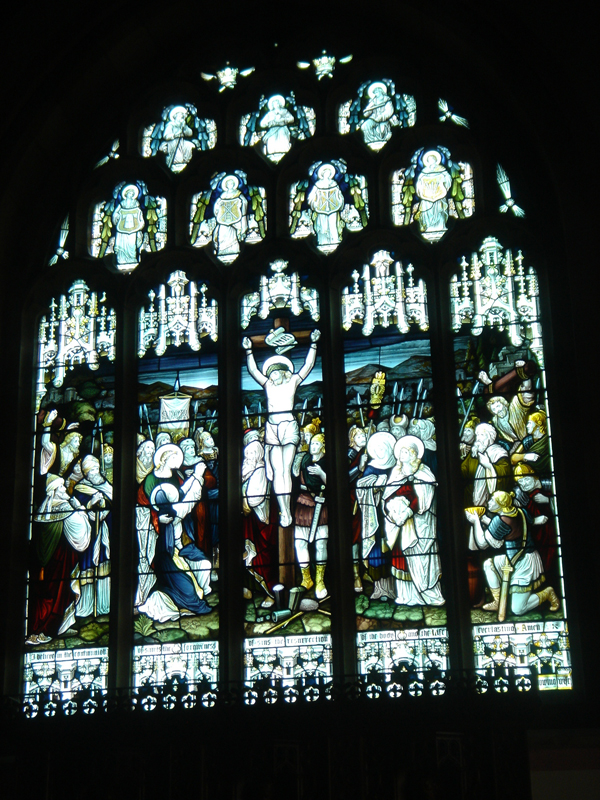
In 1907, Helen and Albert went to France. They planned to return to Canada before Christmas, but Albert became ill and could not travel. Helen was with him when he died in Paris in June, 1908.14 She later arranged for a large stained glass window to be placed in Vancouver’s Christ Church and dedicated to his memory.
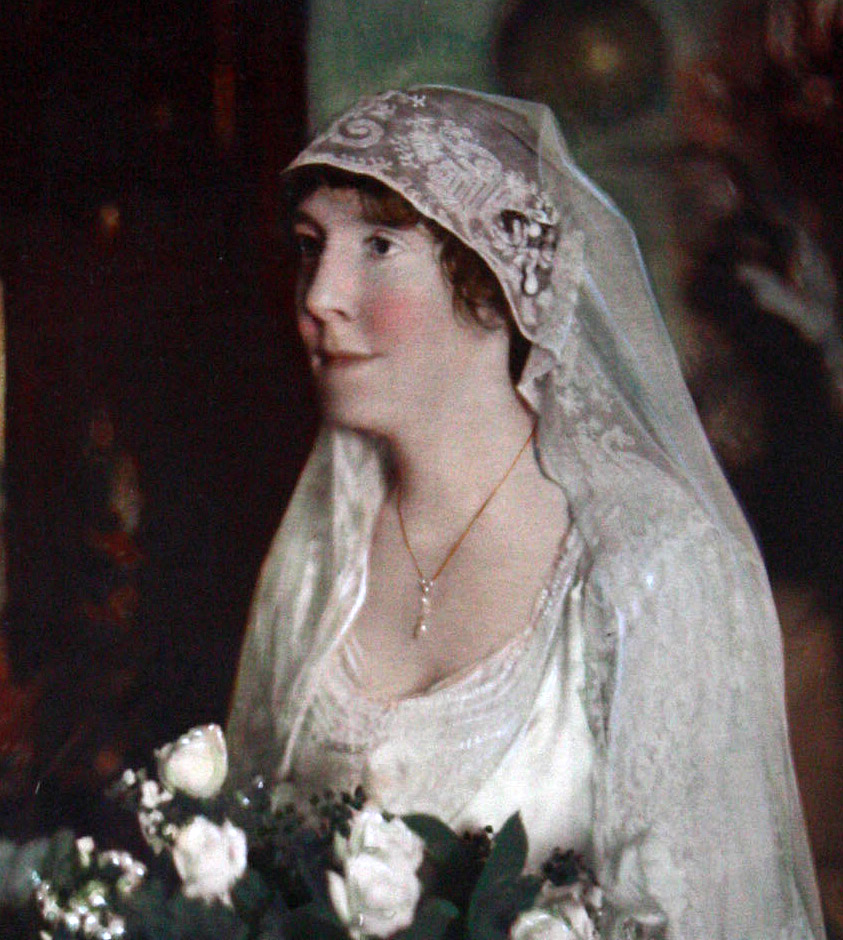
In 1911, Helen remarried at a quiet ceremony.15Her second husband was Vancouver real estate broker Herbert Charles Drummond (1864-1938), a descendant of an aristocratic Scottish family who had worked for a time as a police constable in Telegraph Creek in northern B.C. Helen and Herbert also travelled the world. They went to India in 1911 to attend the Durbar, an event that marked the proclamation of King George V and Queen Mary as Emperor and Empress of India, and they visited England and California.
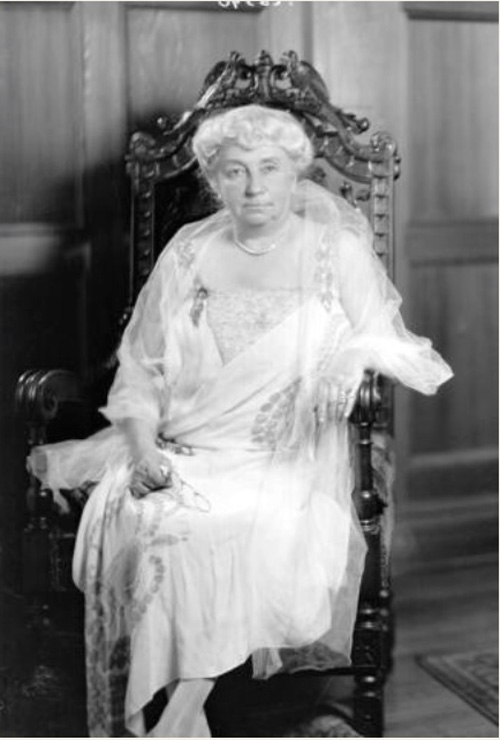
At home, Helen busied herself with philanthropic and social activities, which often overlapped. Her name appeared frequently in the society page of the Vancouver Province.
She hosted visiting family members from Montreal. She played leadership roles in local, municipal and provincial chapters of the Imperial Order of the Daughters of the Empire (IODE) during World War I and through the early 1920s, and she was involved with the Vancouver General Hospital and the National Council of Women. After the war, she and Herbert resumed their travels to Europe, spending two years, 1929 to 1931, abroad.16
Helen died in 193516 after spending almost half her life in Vancouver, and she is buried there in Mountain View Cemetery. Herbert died three years later.17
Thank you very much to Nelson Oliver, Yves Desjardins and Karyn Huenemann for research assistance.
See also:
Janice Hamilton, “Summer in Korea, 1899”, Genealogy Ensemble, Aug. 11, 2021, https://genealogyensemble.com/2021/08/11/summer-in-korea-1899/
Janice Hamilton, “Canadian Tourists in India, 1900”, Genealogy Ensemble, Sept. 22, 2021, https://genealogyensemble.com/2021/09/22/canadian-tourists-in-india-1900/
Photo credits:
“Miss Helen Bagg, Montreal, QC, 1882” Notman and Sandham, II-64197.1, McCord Museum, http://www.mccord-museum.qc.ca/en/collection/artifacts/II-64197.1
Crucifixion Window, Christ Church Cathedral, Vancouver, B.C., photo courtesy Nelson Oliver
“Seated portrait of Mrs. Herbert Drummond” c. 1930, Major Matthews Collection, AM54-S4-N527.20, City of Vancouver Archives, http://searcharchives.vancouver.ca/seated-portrait-of-mrs-herbert-drummond-4
Notes:
- Helen was born 16 September, 1861 and was baptized on 27 November, 1861 at Christ Church, Montreal. See the Vital and Church Records (Drouin Collection), 1621-1967 on Ancestry.ca.
- A one-page biography of Helen in Women of Canada, Montreal, QC: Women of Canada, 1930, page 73, described her childhood, her world travels, her writing and her volunteer activities.
- To learn more about the development of Mile End, the Montreal neighbourhood in which Helen’s family owned property, see the history section of Mile End Memories, http://memoire.mile-end.qc.ca/en/category/histoire-du-mile-end/. Chapter 3.1 focuses on Helen’s grandfather and great-grandfather, Stanley Bagg and John Clark: http://memoire.mile-end.qc.ca/en/le-boucher-john-clark-et-le-marchand-stanley-bagg/ (the text is in English). Chapter 3 looks at the role of Helen’s father, Stanley Clark Bagg: http://memoire.mile-end.qc.ca/en/chapitre-3-deuxieme-partie-stanley-clark-bagg/ (currently in French, with an English version coming soon.)
- Most women in Helen’s day had to rely on their husbands to support them, however, Helen’s father had made provisions in his will to ensure that not only his son and his widow, but also his daughters, would receive income from revenues and interest generated by his estate.
- This transaction appears in a ledger of property sales kept by Helen’s sister Amelia (Mrs. J. Mulholland), held in the Abner and Stanley Bagg Fonds at the McCord Museum in Montreal.
- She married Albert Edward Lewis on 16 April, 1891. This record can be viewed in the Vital and Church Records (Drouin Collection), 1621-1967 on Ancestry.ca. Helen likely had a marriage contract that kept her property separate from Albert’s, a document that is likely in the records of the notary who wrote it and stored at the Bibliothèque et Archives nationales du Québec (BAnQ) in Montreal.
- “Une étrange disparition. D’un agent d’immeubles de cette ville. A-t-il été assassiné? Les circonstances extraordinaires qui entourent cette mystérieuse affaire. La police fait des recherches.” La Patrie, Montreal, 22 November 1897, 1.
- “Know That He Lives. Police Sure That A.E. Lewis Was Not Kidnapped.” The Gazette, Montreal. 25 November, 1897, 4.
- Telephone conversation with Cynthia Lewis, 19 December, 2015.
- Helen may have enjoyed photographing her travels as well as writing about them. Or maybe they were both photographers. On 12 November, 1903, the Vancouver Province reported that members of the Vancouver Photographic Society enjoyed a show of Mr. and Mrs. Lewis’s photos taken in Shanghai, Korea, Japan, Ceylon, India, the Nile River and Venice. Do these photos still exist?
- A post on the blog Canada’s Early Women Writers, https://ceww.wordpress.com/2012/01/16/women-of-canada-1930/, describes the book Women of Canada 1930 and lists the women who are included in it. Helen was listed under her married name, Mrs. H.C. Drummond. I would love to read Helen’s articles about her travels, but she probably would have written under a pseudonym and so far I haven’t been able to find any of them. To confuse matters slightly, there was another writer named Helen Frances Bagg. She was born in Chicago, the daughter of a businessman. That Helen wrote several well-known plays, novels and short stories between about 1905 and 1920.
- Edward Lewis and his wife Helen were counted in Vancouver in the 1901 Census of Canada.
- Society, Vancouver Province, 20 April 1901, 4.
- Edward Lewis, death notice, Vancouver World, June 29, 1908, 13.
- Herbert Charles Drummond was born 4 May, 1864. This record can be found in the India, Select Births and Baptisms, 1786-1947 collection on Ancestry.ca. The record of his marriage to Helen Frances M Bagg on 7 August, 1911 is included in the British Columbia, Canada, Marriage Index, 1872-1935 on Ancestry.ca.
- More stories about Helen’s husbands can be found on WestEndVancouver, https://westendvancouver.wordpress.com/. This site focuses on the streets, houses, businesses and people of the city’s west end from the late 1800s to 1920. The site includes extensive references to newspaper articles, passenger records and other resources. See the story of Albert Edward Lewis, https://westendvancouver.wordpress.com/biographies-a-m/biographies-l/lewis-albert-edward-1860-1908/ and the article about Herbert Charles Drummond, https://westendvancouver.wordpress.com/biographies-a-m/biographies-d/drummond-herbert-charles-1864-1938/
- The death in a Vancouver hospital of Helen F M Drummond on 19 April, 1935 is listed in British Columbia Death Registrations, 1872-1986 on FamilySearch.org. The Certificate of Registration of Death indicates she was buried four days later at Mountain View Cemetery. Her death certificate and an article about her funeral in the Vancouver Province gave her age as 72, but she was actually 73.
- Vancouver Province, 14 July, 1938, 18.