Category: Bagg

A Mediterranean Cruise in 1910

In 1910, my mother’s great-aunt Katharine Sophia (Bagg) Mills (1850-1938) and her husband, Reverend William Lennox Mills, the Anglican Bishop of Ontario, visited Europe and the Holy Land. They had been to Europe before, but this was a long awaited trip to visit the places they had read about in the Bible. After returning home to Kingston, Katharine published an account of her trip, Reminiscences of a Cruise in the Mediterranean and a Visit to the Holy Land and Egyptby Mrs. W. Lennox Mills.

This trip took place 110 years ago, when travel was slower and there was greater diversity in the dress and customs of different countries than there is today, nevertheless, their adventures would probably sound quite familiar to cruise passengers of today. Katharine left out the names of her fellow travellers and details of many personal incidents (though I wish she hadn’t), but she did share her impressions of the sights they saw.

The couple set sail from New York on January 20, 1910 aboard the S.S. Arabic, making an eight-day crossing of the Atlantic to the Portuguese island of Madeira. Katharine described her first view of the island: “Mountains, rising one above another, formed a fine background, and there were three high hills, shaped just like bee-hives with rounded domes, quite unique in appearance. The colouring of the picture was superb: blue sea, blue sky, with downy white clouds, green hills, purple shadows, red and grey rocks, white houses with red roofs, and a picturesque old grey fort, crowning the summit of one of the hills.”

Later in the day, after wandering around the town of Funchal, they joined a small group of fellow visitors and hired a motor car. “We dashed through some neighbouring villages and brought the inhabitants rushing to their doors; some in admiration of our rapid flight, and others looking greatly amazed and alarmed.” She noted the clothes worn by the locals: the men in cone-shaped knitted caps, the women with gaily coloured kerchiefs on their heads. The following day, they took a funicular railway to the top of a nearby mountain. “Then came a most exciting experience in descending from the lofty height. We got into a sort of basket carriage on runners, guided by two men holding ropes, and rushed down, with incredible swiftness, over the hard cobble stones.”

After leaving Madeira, they visited Cadiz and took a special train to Seville, returning the following day to the S.S. Arabic.

Their next stops included Gibraltar, Algiers, Malta and Athens. Katharine described a thrilling moment in Athens: “We climbed by very steep and natural steps in the solid rock, to the top of the Areopagus and ‘stood on Mars Hill,’ where the great Apostle St. Paul also stood in 54 A.D., and preached to the ‘Men of Athens,’ declaring unto them the ‘unknown God.’”

They steamed on through the Straights of the Dardanelles to Constantinople (now Istanbul.) “Seen from the ship, the great City of Constantine is bewilderingly beautiful, with its white palaces, many domes and graceful minarets,” she wrote, but, as they crossed a bridge, she described seeing “a motley crowd” of Arabs in hooded robes, Jews with long beards and Turks wearing loose trousers and red fez caps, as well as donkeys with heavily laden baskets and men carrying large boxes of fruit and vegetables on their backs.

The next port of call was Smyrna where, Katharine noted, Christianity laid down deep roots at an early time. From there, they travelled to Ephesus, a great ancient city that was home for a time to both St. John and St. Paul.

They decided to go to see the ruins of the Agora, the Theatre and the Library, which were four miles away and, since there were no carriage roads, they had to ride. The Bishop, as Katharine referred to her husband, was given a white horse, which proved to be “quite a terror,” although William eventually managed to control his mount. Katharine, who had probably learned to ride as a child, was on a donkey. “He seemed to take complete command of the situation, and I had no alternative but to let him have his own way.… Sometimes we would go down an almost perpendicular hill … at other times we would push our way through brier and thorn, or sink for several inches in muddy fields.” She claimed she was not the least bit nervous.

In Lebanon, they were joined by their dragoman, or guide, a Syrian who spoke English well and had been educated at a Quaker school near “Beyrout.” They took a train through the snow-capped mountains of Lebanon and arrived in Damascus, where they stayed at the clean and comfortable Victoria Hotel. (There always seemed to be an English-run hotel in these cities.)

In Damascus, they visited a mosque that housed a sarcophagus containing what was said to be the head of St. John the Baptist, and they saw the tomb of Saladin, who fought the Crusaders. The following day, they travelled by train to Tiberias, on the Sea of Galilee, their first stop in the Holy Land.

Notes

Reminiscences of a Cruise in the Mediterranean and a Visit to the Holy Land and Egypt by Mrs. W. Lennox Mills can be found in several Canadian university libraries, and online.

According the Bagg family Bible, which is in the archives of the McCord Museum, Montreal, Katharine Sophia Bagg was born July 4, 1850 at Fairmount Villa, Montreal. The eldest daughter of Catharine Mitcheson and Stanley Clark Bagg, she grew up with her older brother and three younger sisters. On Oct. 12, 1886, she married Canon William Lennox Mills at Christ Church, Montreal. Their only child, Arthur Lennox Stanley Mills, was born in Montreal on June 27, 1890. At one time rector of Anglican Trinity Memorial Chapel in Montreal, William was Bishop of Ontario from 1901 until his death in 1917, and the couple lived in Kingston for many years. Katharine died at her apartment in Montreal on January 31, 1938.

Shirley C. Spragge, “MILLS, WILLIAM LENNOX,” in Dictionary of Canadian Biography, vol. 14, University of Toronto/Université Laval, 2003– (accessed October 16,  2019), www.biographi.ca/en/bio/mills_william_lennox_14E.html.
Daniel Bagg’s Will

This is the sixth in a series of posts about four generations of my ancestors in colonial Massachusetts and Connecticut. It includes the Bagg, Burt, Phelps, Moseley, Stanley and other related families between 1635 and 1795.

When I revised my will last year, although it expressed my wishes, its legal language felt impersonal. Reading Daniel Bagg’s will, written in 1737, was a very different experience: it gave a real glimpse of his character, revealing his love for his wife, his trust in his sons, and his generosity to his daughters.

Daniel’s will also acknowledged that God had blessed him in this life, which was a very Puritan thing to say. The Puritans of New England attributed everything that happened to them to God’s will.

Daniel Bagg (1668-1738) was a farmer in Westfield, a small town founded in 1669 on the western frontier of Massachusetts. He and the town’s other residents lived in a tightly knit community, centered around the building that doubled as the town meeting house and the Congregational church. 

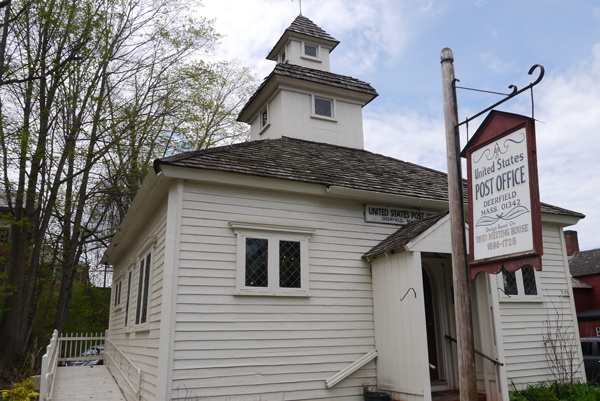
Daniel would have attended meetings and church services in a building similar to this one in nearby Deerfield, MA.

Agricultural fields were spread out across the surrounding areas. The hills, plains and riverside meadows of the Westfield area had fertile soil and provided growing conditions for a variety of crops, including corn, wheat and flax.

Most of Westfield’s early residents had come from either Springfield, Massachusetts or Windsor, Connecticut, and Daniel was no exception. He was born in Springfield in 1668, one of 10 children born to John Bagg and Hannah Burt.1

Daniel’s mother died when he was 12 years old, and his father died three years later. It is not clear who raised him and his eight surviving brothers and sisters after that. His father’s probate records show that Sam Marshfield was to be a guardian to sons John and James, and to Abilene, the youngest child, but there was no mention of Daniel or the other children.2 Perhaps their mother’s family cared for them.

When they became adults, John and Jonathan Bagg (James had died young), settled in West Springfield, on the west bank of the Connecticut River, where their father had owned land.

Daniel probably moved to Westfield around the time he married, in January 1693/94.3 His wife was Hannah Phelps, born in 1675 to Isaac Phelps and Ann Gaylord. Isaac Phelps had been a founding resident of Westfield and was a community leader there. Perhaps this connection to the Phelps family helped Daniel become a prominent citizen of Westfield.

In land deeds and court documents, Daniel was described as a farmer and wheelwright and, in the later part of his life, as a merchant or trader. Perhaps Daniel’s activities as a merchant brought good income, although his name appeared in several lawsuits, primarily because he either owed money or money was owed to him.4

Daniel served as a selectman (town official) of Westfield in 1718 and 1723. He represented the town in the Massachusetts legislature for a year5 and he was involved in several committees at Westfield’s Church of Christ.6

Daniel and Hannah, who were my six-times great-grandparents, had 11 children: three boys, one of whom died as an infant, and eight girls. Their youngest son, David, was my direct ancestor.

I am not sure whether the girls’ marriages are correct in the following list; Daniel did not mention any of their husbands in his will. The couple’s 10 surviving children were: Hannah, b. 1695, m. ?; Daniel Jr.,  b. 1697, m. Abigail Dewey; Ebenezer b/d 1700; Rachel, b. 1702, m. Aaron Phelps; Ann, b. 1704, m. John Field; Abigail, b. 1707, m. Isaac Dewey; Ruth, b. 1709, m. Daniel Dickason; Margaret, b. 1712; Sarah, b. 1714, m. ?; David, b. 1716/1717, m. Elizabeth Moseley.7 Following Elizabeth’s death in 1759, David married two more times.

Daniel prepared his will in 1737 and signed it with his mark, suggesting that, although he may have known how to read, he could not write. He died Aug. 18, 1738, age 70.8

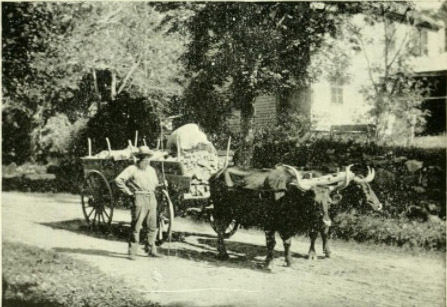
An ox cart in Westfield

He left to his “dearly beloved wife during her natural life” one end of “my dwelling house and part of the cellar with the one half of the garden, as also one quarter of the orchard by the house and one quarter of the land by the house that was called the homestead, being two acres and a half.”

Daniel left all his farmland in Westfield to his two sons, Daniel Jr. and David, to share equally. Daniel Jr. was to have the new house and David the old house and barn, and Daniel was to give David 60 pounds to enable him to make improvements. David was also to have the team of oxen.

To each of his daughters, Daniel left “100 pounds with what she has already had.” He showed special concern for daughter Abigail, who was married to Isaac Dewey, and her children, leaving them extra money. He gave Daniel and David a deadline to make sure his daughters received their bequests – and extra time to come up with the funds if there was not enough in his personal estate.

See also:

Janice Hamilton, “John Bagg of Springfield, Massachusetts,” Writing Up the Ancestors, Feb. 22, 2018, https://www.writinguptheancestors.ca/2018/02/john-bagg-of-springfield-massachusetts.html

Janice Hamilton, “Isaac Phelps and His Blended Families,” Writing Up the Ancestors, May 3, 2018, https://www.writinguptheancestors.ca/2018/05/isaac-phelps-and-his-blended-families.html

Sources:

  1. Massachusetts: Vital Records, 1621-1850 (Online Database: AmericanAncestors.org, New England Historic Genealogical Society, 2001-2016).https://www.americanancestors.org/DB190/r/1320087835
  2. Hampshire County, Massachusetts probate records 1660-1916. index, 1660-1971 [microform]
  3. New England Marriages to 1700. (Online database. AmericanAncestors.org. New England Historic Genealogical Society, 2008.) Originally published as: New England Marriages Prior to 1700. Boston, Mass.: New England Historic Genealogical Society, 2015. https://www.americanancestors.org/DB1568/i/21174/65/426875386
  4. Debrett, “The Bagg Family of Massachusetts, America and of Montreal, Canada. Research for Mrs. J.D. Hamilton, July, 1980.”
  5. Massachusetts: Legislators of the General Court, 1691-1780 (Online database: AmericanAncestors.org, New England Historic Genealogical Society, 2002), (Orig. Pub. by Northeastern University Press , Boston, MA. John A. Schutz, Legislators of the Massachusetts General Court 1691–1780 A Biographical Dictionary, 1997.) https://www.americanancestors.org/DB142/r/5875254
  6. Rev. John H. Lockwood, Westfield and its Historic Influences 1669-1919: The Life of an Early Town (Springfield, 1922, Printed and sold by the author), p. 147, 310, https://archive.org/stream/westfieldandits00lockgoog#page/n174/mode/2up, accessed May 19, 2018
  7. Daniel’s and Hannah’s girls and boys are listed separately in the Massachusetts Vital Records 1620-1850. For example, the girls’ births in Westfield are in vol. 1, page 50; the boys are on page 3. Females births: Massachusetts: Vital Records, 1621-1850 (Online Database: AmericanAncestors.org, New England Historic Genealogical Society, 2001-2016). https://www.americanancestors.org/DB190/i/13250/50/253012007 Males births: Massachusetts: Vital Records, 1621-1850 (Online Database: AmericanAncestors.org, New England Historic Genealogical Society, 2001-2016). https://www.americanancestors.org/DB190/i/13250/3/253010247 Females marriages: Massachusetts: Vital Records, 1621-1850 (Online Database: AmericanAncestors.org, New England Historic Genealogical Society, 2001-2016). https://www.americanancestors.org/DB190/i/13251/81/253016859 Males marriages: Massachusetts: Vital Records, 1621-1850 (Online Database: AmericanAncestors.org, New England Historic Genealogical Society, 2001-2016).https://www.americanancestors.org/DB190/i/13251/4/253014174
  8. Massachusetts: Vital Records, 1621-1850 (Online Database: AmericanAncestors.org, New England Historic Genealogical Society, 2001-2016), https://www.americanancestors.org/DB190/i/13250/91/253013579
  9. Hampshire County, MA: Probate File Papers, 1660-1889. Online database. AmericanAncestors.org. New England Historic Genealogical Society, 2016, 2017. (From records supplied by the Massachusetts Supreme Judicial Court Archives and the Hampshire County Court. Digitized images provided by FamilySearch.org) https://www.americanancestors.org/DB1653/i/33925/7-17-co3/0