Category: Bagg

William the Conqueror and Me

William the Conqueror must have thousands of descendants, but it seems quite a coincidence that I had thoroughly researched his life before I was aware there was a direct connection between us.

I learned about that connection from Gary Boyd Roberts, Senior Researcher Emeritus of the New England Historic Genealogical Society (NEHGS) and author of many books, including The Royal Descents of 600 Immigrants to the American Colonies of the United States. A half-hour meeting with Roberts was part of a weekend research event at the NEHGS that I attended a few years ago.

Roberts was a bit intimidating. He insisted I not look at my notes, but look at him, and he was baffled that I was interested in my ancestors’ lives. For him, the births, marriages and deaths were all that mattered. He seemed to have memorized the lineages of just about every family in colonial New England, and he indicated the pages of the family history books I should photocopy. When he learned I am Canadian, Roberts remarked that I have a “nice chunk of Yankee.”

He then pointed to the name Margaret Wyatt on my family tree and stated, “she was of royal descent.”
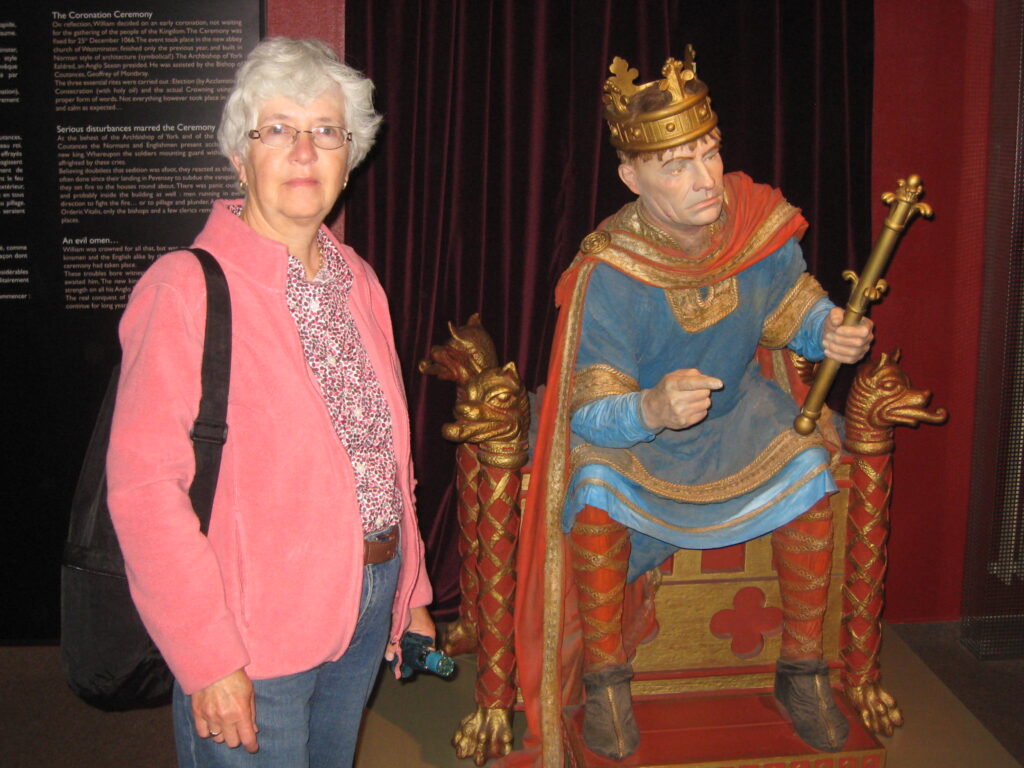
When I posed with this wax William in 2009, at the Bayeux Tapestry exhibit in France, I had no idea we were related.

That royal ancestor was King Henry I, but the name did not ring any bells until I returned home and looked up Henry I on the Internet. Then I realized that Henry was the youngest son of William the Conqueror, about whom I had written a book!1 The book told the story of how William, Duke of Normandy, became King William I of England almost thousand years ago. Titled The Norman Conquest of England, it is one of several non-fiction books I have written for children.

William’s own ancestry was actually Viking: the Normans were people from Scandinavia who began raiding northern France around 800 A.D. In 911, William’s ancestor Rolf the Viking took control of the area that became known as Normandy.

William was born in Normandy around 1028, the illegitimate son of Duke Robert I of Normandy and a young woman named Herleve, who was probably the daughter of a tanner. Even as a child, William had many rivals, but eventually he succeeded his father as Duke of Normandy.

In 1066, he famously crossed the English Channel and defeated the English troops at the Battle of Hastings. He was a powerful and violent man, and a good military commander. The story of how William the Conqueror evaded his enemies and invaded England is full of intrigue and coincidences. After writing about these events, my husband and I toured northern France, including Bayeux, home of the Bayeux Tapestry that illustrates the Norman Conquest. Little did I know at the time that William was one of my ancestors.

After William I’s death in 1087, his son William Rufus became king of England. Following the death of Rufus, William the Conqueror’s youngest son became King Henry I. Henry, who had been born in England, ruled from 1100 to 1135. Well educated, decisive and energetic, he was known as the Lion of Justice.

Henry married Matilda of Scotland, but the line of descent that leads to America was through an unnamed mistress. Their illegitimate child was Robert of Caen, 1st Earl of Gloucester. At generation 19 came Margaret Wyatt ( –  c. 1675).2 She married Matthew Allyn (1605-1671) in Devonshire, England in 1626/27 and a few years later they sailed across the Atlantic, settling in Hartford and later in Windsor, Connecticut.

From there, my line goes through their daughter Mary Allyn who married Benjamin Newberry; their daughter Mary Newberry who married John Moseley; their son Consider Moseley, who married Elizabeth Bancroft; and their daughter Elizabeth Moseley who married David Bagg in Westfield, Massachusetts. Their son Phineas Bagg, my four-times great-grandfather, left New England for Montreal, Quebec with his children around 1795.4

See also: 

Janice Hamilton, “Considering Consider Moseley,” Writing Up the Ancestors, May 16, 2018, writinguptheancestors.ca/2018/05/considering-consider-moseley.html

This article is also posted on https://genealogyensemble.com

Sources.

  1. Janice Hamilton, The Norman Conquest of England, Minneapolis: Twenty-First Century Books, 2008.
  2. Gary Boyd Roberts, compiler, Ancestors of American Presidents,2009 Edition. Boston: New England Historic Genealogical Society, 2009, p. 408.
  3. The Great Migration Begins: Immigrants to New England 1620-1633, Volumes I-III. (Online database: AmericanAncestors.org, New England Historic Genealogical Society, 2010), (Originally Published as: New England Historic Genealogical Society. Robert Charles Anderson, The Great Migration Begins: Immigrants to New England 1620-1633, Volumes I-III, 3 vols, 1995) https://www.americanancestors.org/DB393/i/12107/42/235171345
  4. Janice Hamilton, “An Economic Emigrant,” Writing Up the Ancestors, Oct. 16, 2013, https://www.writinguptheancestors.ca/2013/10/an-economic-emigrant.html
A Visit to the Old Burying Ground of Westfield, Massachusetts

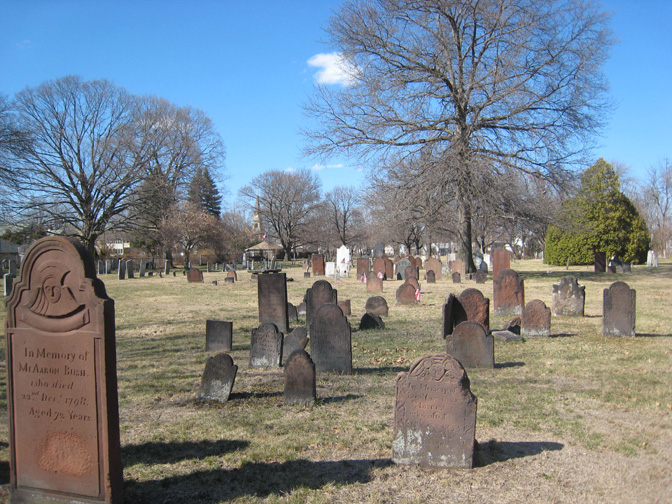
The Old Burying Ground, Westfield, Massachusetts

I have always been fascinated by the carved images found on early American gravestones.

Imagine how thrilling it was to discover that this kind of tombstone marked the final resting place of one of my colonial New England ancestors in Westfield, Massachusetts. I found it when I visited Westfield’s Old Burying Ground a few years ago, en route to the New England Regional Genealogical Conference which was being held in nearby Springfield.

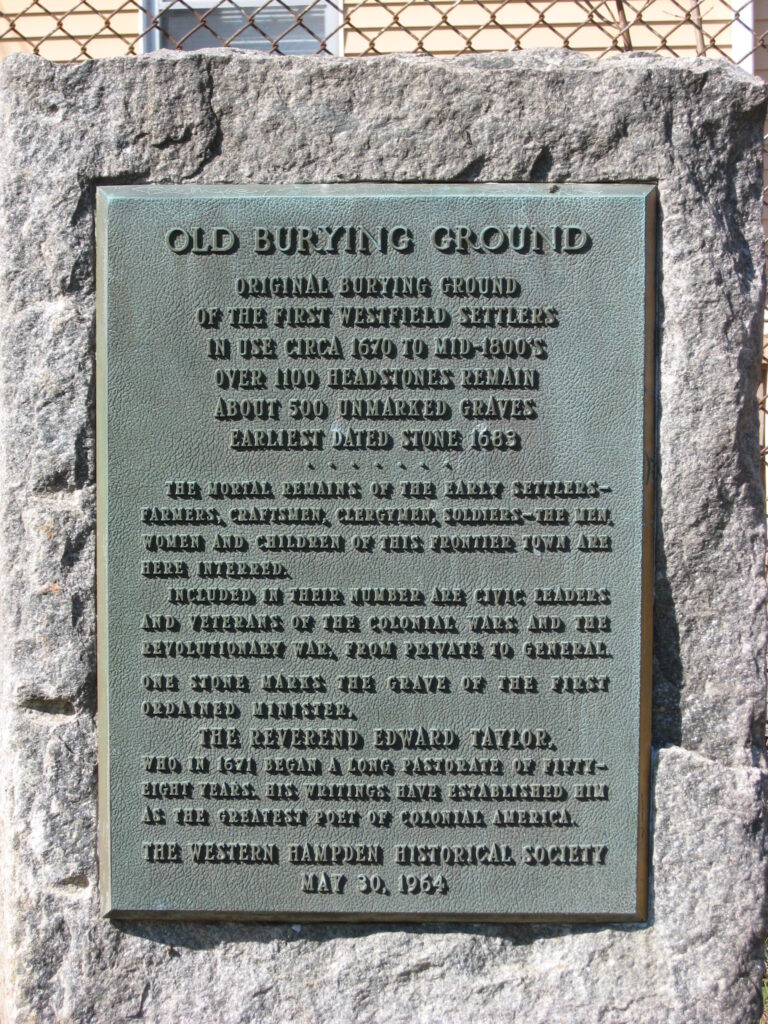
A plaque outlines the history of the Old Burying Ground, Westfield, MA

Westfield was founded in 1669. The oldest known gravestone in the burying ground is that of Abigail Noble, who died in 1683. Childbirth, consumption, dysentery, smallpox and accidents were common causes of death, but a surprisingly large number of those interred here lived to more than 80 years of age.

Among the more than 1100 gravestones and several hundred more unmarked graves in this cemetery, I was looking for the resting places of three of my direct ancestors: my six-times great-grandfather Daniel Bagg, his father-in-law, Isaac Phelps, and his son’s father-in-law, Consider Moseley. I found them in the southeast section of the cemetery where many of the oldest plots are located.1

My first stop was the Athenaeum (the public library) to pick up the key to the cemetery. From there, it was a short walk to what is known as the Mechanic Street Cemetery. Set back from street between two houses, the wrought iron gate was a bit hard to find, but once I entered the cemetery, I was amazed at how large it is, and how well cared for. This old burying ground, which is included in the U.S. National List of Historic Places, was carefully weeded and mowed, protected by a fence and shaded by mature trees. The historic tombstones have been cleaned over the years, and local citizens are trying to find the funds to better preserve them..2

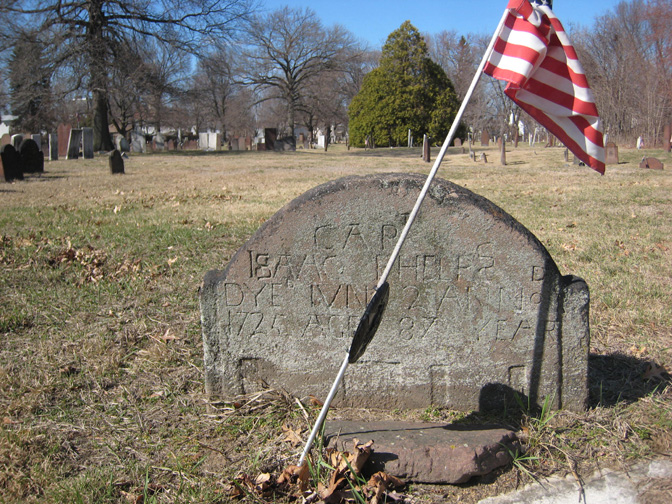
Grave of Isaac Phelps

The grave of Captain Isaac Phelps (1638-1725) was easiest to find because there was a small American flag next to it. Carved in capital letters on his gravestone are, the words, “Capt. Isaac Phelps Anno 1725  age 87 year.” Westfield lay at the western edge of the Massachusetts Bay Colony and the tiny settlement was vulnerable to attack from American Indians, so Isaac probably played a role in protecting the community, and a military title acknowledged that contribution.

Born in Windsor, Connecticut to George Phelps and Philura Randall, Isaac Phelps married Ann Gaylord around 1663 and moved his family to Westfield around 1670. Isaac carried out many civic duties in Westfield over the years: he was town clerk, assessor, surveyor, town treasurer and schoolmaster.3

Isaac and Ann had 11 children, four of whom died young.4 He and Ann were my seven-times times great-grandparents through daughter Hannah, who married Daniel Bagg (1668-1738).  

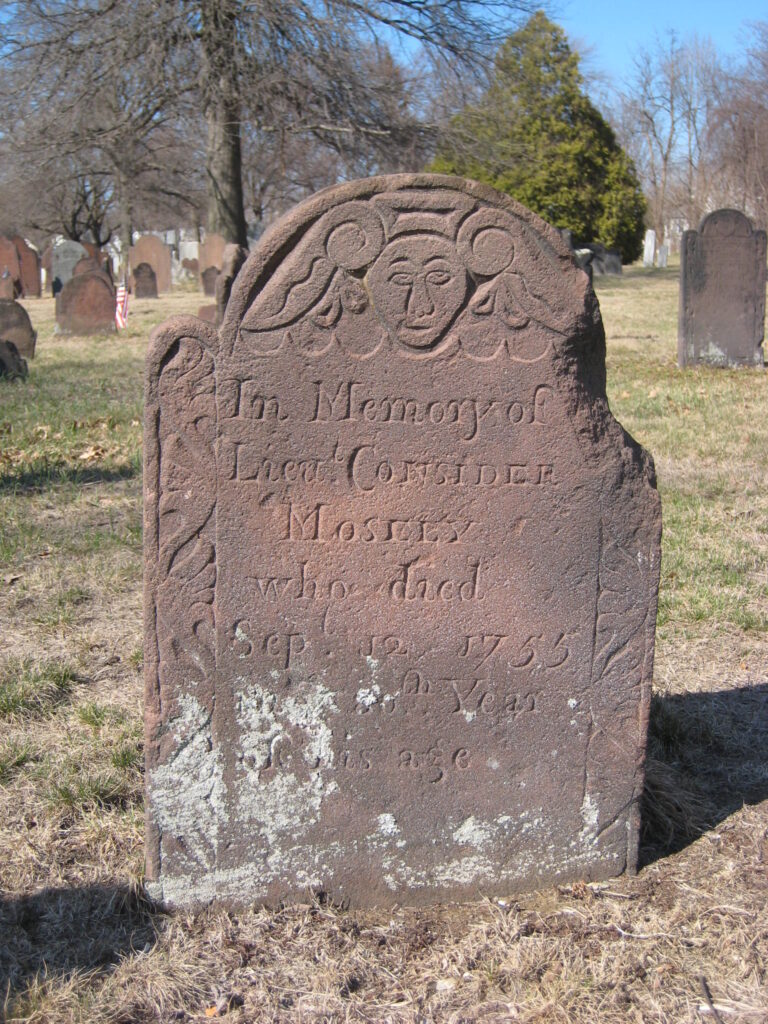
Lieut. Consider Moseley’s red sandstone tombstone, with a carved face, crown and wings symbolizing everlasting life, was close to Isaac’s.5

Consider Moseley’s gravestone

Consider (1675-1755) was the fifth of 10 children of John Maudsley (the name was spelled various ways) and Mary Newberry. The Maudsley/Moseley family moved from Windsor to Westfield around the time of Consider’s birth.

In 1709, when Consider was 34 years old, he married Elizabeth Bancroft.They had eight children, including twins Elizabeth and Daniel, born in 1714. After his first wife died, Consider married widow Rebecca Dewey. His daughter Elizabeth married David Bagg, the son of Daniel Bagg and Hannah Phelps, in 1739.

According to a history of Westfield, Lieut. Consider Moseley was “one of the wealthiest and most influential men of the town,” however, I have found few details of his life.6 He died on Sept. 12, 1755, age 80.

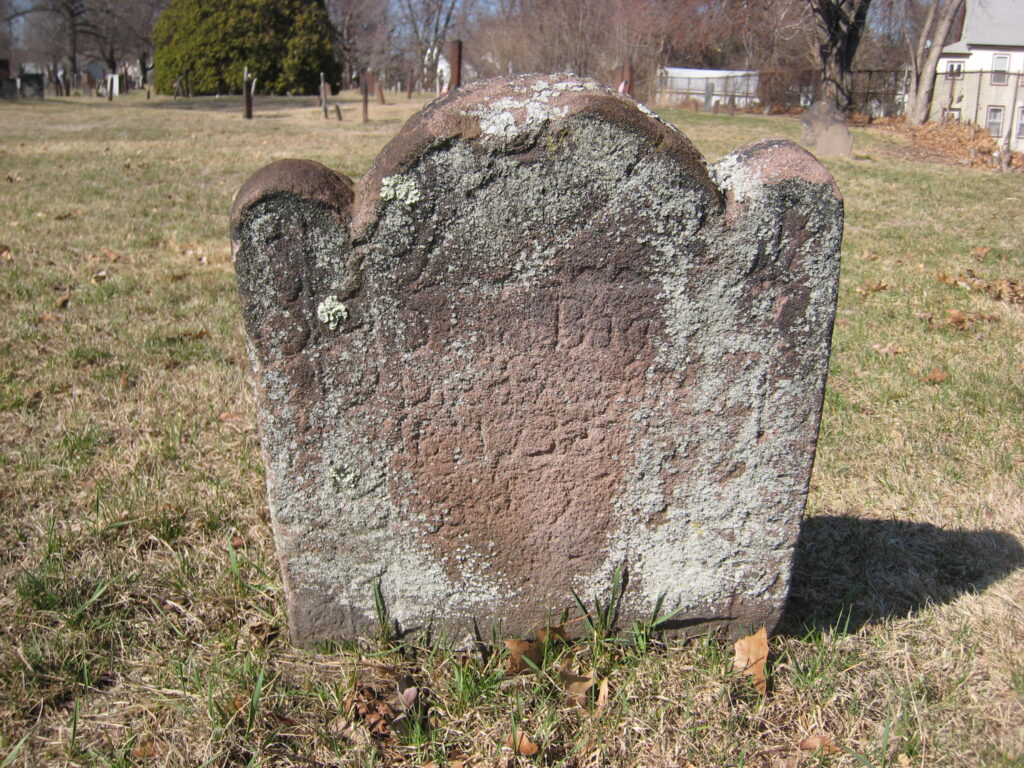
The grave of Daniel Bagg was more difficult to identify. The stone that I suspect marks his grave is almost illegible. The other problem is that there are three individuals named Daniel Bagg buried in this cemetery.

Possibly Daniel Bagg’s gravestone

The Daniel Bagg I was seeking was the son of John Bagg and Hannah Burt of Springfield. Many of Springfield’s younger residents moved to Westfield. Daniel became a farmer in the Little River area of Westfield. He and his wife Hannah Phelps had 10 children, and their son David and his wife Elizabeth Moseley were my direct ancestors.

Ann Gaylord, Elizabeth Bancroft, Hannah Phelps and Elizabeth Moseley are also likely buried in the Old Burying Ground, but their graves are not marked.

Photo credits: Janice Hamilton

This article has also been posted on the collaborative blog https://genealogyensemble.com.

Sources:

  1. Old Burying Ground Mechanic Street Cemetery. http://www.cityofwestfield.org/DocumentCenter/View/419a, accessed March 11, 2018. (The name Bagg is misspelled Back in this 1995 inventory.)
  2. Dan Warner. “After 350 Years, Old Burying Ground in need to a fix-up in Westfield.” Masslive.com, June 27, 2014, http://www.masslive.com/news/index.ssf/2014/06/after_350_years_old_burying_gr.html, accessed March 11, 2018.
  3. Oliver Seymour Phelps and Andrew T. Servin, compilers. The Phelps Family of America and their English Ancestors, with copies of wills, deeds, letters and other interesting papers, coats of arms and valuable records. Vol. II, Pittsfield, MA: Eagle Publishing Company, 1899, p. 1269.
  4. Henry R. Stiles. The History of Ancient Windsor, Vol. II, a facsimile of the 1892 edition, Somersworth: New Hampshire Publishing Co., 1976. p. 509.
  5. Bob Clark, Stories Carved in Stone: Westfield, Massachusetts, West Springfield, Dog Pond Press, 2008.
  6. Rev. John H. Lockwood. Westfield and its Historic Influences, 1669-1919: the life of an early town. Springfield, MA, printed and sold by the author, 1922, p. 384. https://archive.org/stream/westfieldandits00lockgoog#page/n413/mode/2up, accessed March 23, 2018.