
Category: Bagg

Great-Aunt Amelia’s Christmas Goblet

Every year at Christmas dinner, my husband toasts our guests with a small antique goblet. His gesture has become a new family tradition. Before he came across this goblet in our kitchen cupboard, it had sat unused at my parents’ Montreal home for decades. I had no idea what it was or how it came into the family.
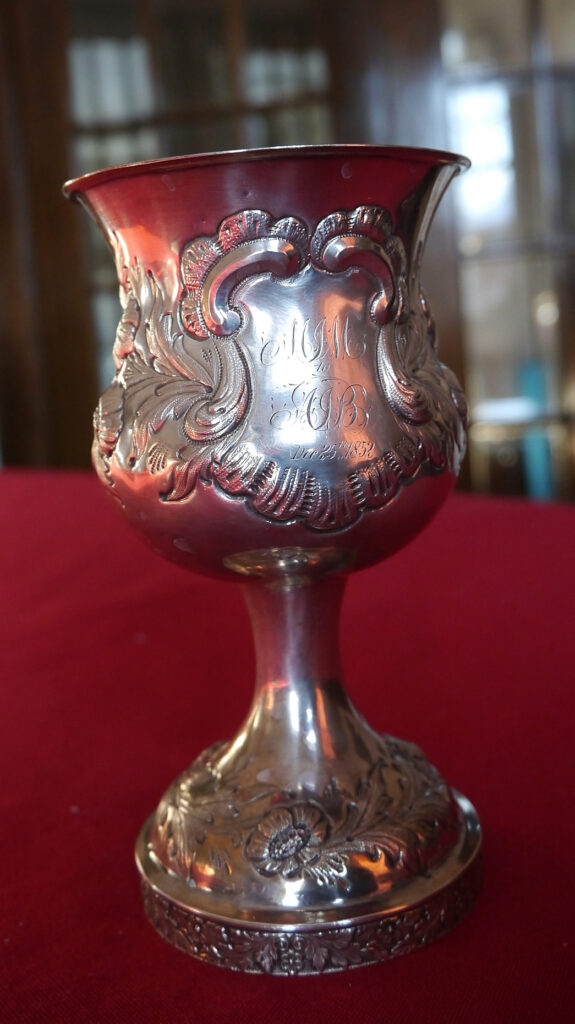
A pattern of flowers and leaves encircles the metal goblet and the initials and date “MJM to AJB Dec. 25 1852” are inscribed. I realized it must have originally been a Christmas gift, but from whom and to whom?

Research revealed that MJM was MacGregor Joseph Mitcheson (1828-1886), and AJB was his 10-month-old niece Amelia Josephine Bagg (1852-1943). This must have been a gift MacGregor sent Amelia for her first Christmas. A fancy goblet seems like a rather strange present for a young man to give a baby, so perhaps it was a tradition, or his parents’ idea.

Amelia was the second surviving daughter of Montreal notary and landowner Stanley Clark Bagg (1820-1873) and his wife, Catharine Mitcheson Bagg (1822-1914). Catharine’s family lived in Philadelphia and McGregor J. Mitcheson was the youngest of her three brothers. In 1852, he was age 24 and a law graduate of the University of Pennsylvania who had recently been admitted to the bar of Philadelphia. 

Despite the distance between the two cities, Catherine Mitcheson Bagg and her brother seem to have been quite close, so perhaps McGregor and Amelia eventually got to know each other. Amelia was 21 when her father died in 1873, and McGregor was one of the executors of Stanley Clark Bagg’s will, so he may have travelled to Montreal to advise his sister on family matters. 
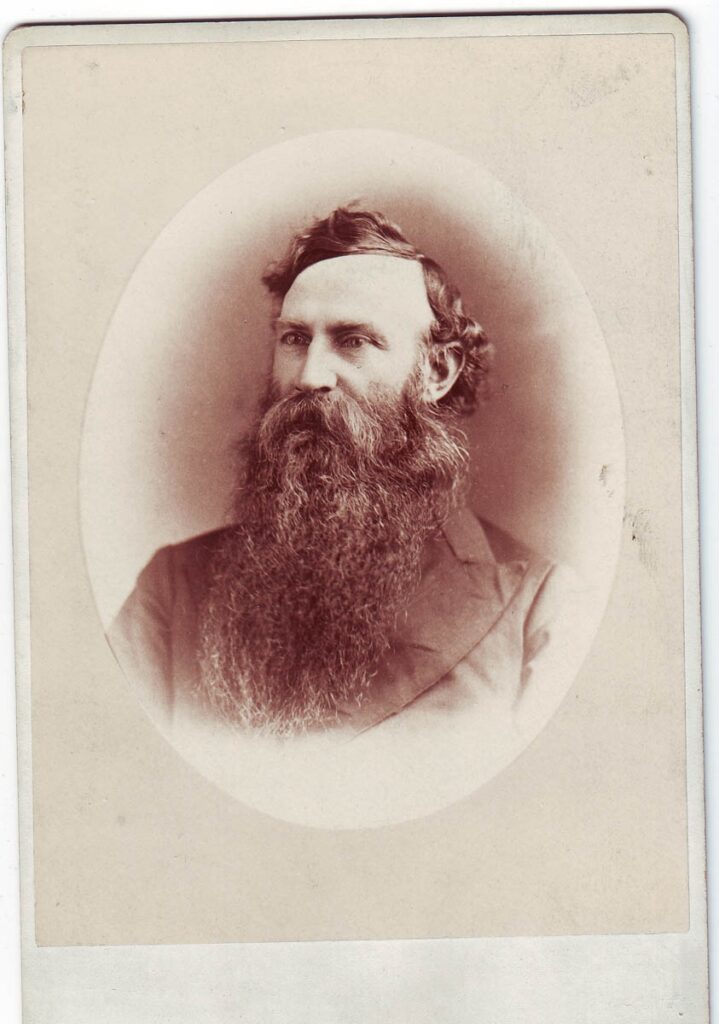

MacGregor J. Mitcheson

MacGregor must have been an unforgettable house guest. His blue-grey eyes and long brown beard give him a rather wild appearance.1 He also had a forceful personality. In a book on Philadelphia lawyers, written some 30 years after MacGregor’s death, a former colleague recalled, “There never was an advocate who fought harder, or who merged his excessively egotistic personality more completely in that of his client. In another important sense was he entitled to great praise. He had a ready and instinctive perception of every essential fact in a case, in all its bearings, and a fine gift of memory for retaining them …..”2

Professionally, he specialized in real estate law. In the community, he was involved in the charity work of the United States Sanitary Commission at the time of the U.S. Civil War, he was president of the Northern Home for Friendless Children and Soldiers’ Orphans for many years, and he was an active member of the Protestant Episcopal Diocese of Pennsylvania.3

MacGregor married at age 41 to Ellen Brander Alexander Bond, a widow, and together they had three children. One died as a child, one did not marry and one married but had no children.

As for MacGregor’s niece Amelia, she also married relatively late at life. She married her first husband, real estate agent Joseph Mulholland, in 1890 and he died seven years later. Her second husband, Rev. John George Norton, Anglican Archdeacon and Rector of Montreal, was a widower.

Amelia had no children of her own, but she was quite close to her niece Gwendolyn Bagg (1887-1963) and Gwen’s husband, Fred Murray Smith — my future grandparents. They probably inherited the goblet when Aunt Amelia died, age 86, in 1938. For them, it would have been a precious reminder of a favourite aunt and a link to a great-uncle who died the year before Gwen was born. 

Photo of MacGregor J. Mitcheson by Wm. Notman & Son, Montreal; Bagg family collection. 

This article is also posted on https://genealogyensemble.com

Notes and Sources

I have described the goblet as metal because I do not know whether it is silver or pewter. There is no hallmark on it. 

MacGregor J. Mitcheson was born Joseph MacGregor Mitcheson on Nov. 26, 1828 and died at age 57 on June 29, 1886. These dates are according to the cemetery records of St. James the Less Episcopal Church, Philadelphia. The records of St. John’s Protestant Episcopal Church, Northern Liberties, Philadelphia, held at the Historical Society of Pennsylvania in Philadelphia, say he was baptized on April 17, 1829. 

MacGregor eventually lived on Locust Street in downtown Philadelphia in a house designed by architect Frank Furness. See http://www.waymarking.com/waymarks/WMG1GH_MacGregor_Mitcheson_House_Philadelphia_Pennsylvania

  1. “U.S. Passport Applications, 1795-1925,” Ancestry.ca[database on-line] entry for MacGregor J. Mitcheson, 1865; National Archives and Records Administration, Washington DC. ARC Identifier 56612/MLR Number A1 508, NARA Series M1372; Roll # 127.  
  2. Robert D. Coxe, Legal Philadelphia: Comments and Memories, Philadelphia: W.J. Campbell, 1908, p. 140, accessed March 3, 2013.
  3. An Historical Catalogue of the St. Andrews Society of Philadelphia with Biographical Sketches of Deceased Members, 1749-1907, printed for the Society, 1907; Google Books, accessed July 19, 2013.
My great-great aunts, Montreal real estate developers

When Montreal landowner Stanley Clark Bagg (1820-1873) wrote his will in 1866, he tried to ensure that his wife, son and four daughters would be financially secure after his death. In this concern he was similar to many 19th-century Montreal husbands and fathers, 1although he was in a better financial situation than most to make sure that this happened. He probably would have been surprised, however, to discover how his widow and daughters became actively involved in the family business.  

Stanley Clark Bagg (henceforth referred to as SCB)2inherited extensive properties on the Island of Montreal from his grandfather John Clark.3 During his lifetime, he made money by leasing and selling that land. He planned his will so that these properties would generate income for three generations of his family. The will stipulated that, when lots from his Estate were sold, the new owner would have to pay a rental fee (called a rente constituée in French) on an ongoing basis. 4 These sums would benefit his widow, children and grandchildren.

However, society was changing in Montreal and rente constituée was an old-fashioned idea. Property laws in the province of Quebec were modernizing, especially after 1840 when the seigneurial system of land ownership that dated back to colonial New France disappeared on the Island of Montreal.

SCB’s family quickly realized that the rente constituée made land from the Bagg Estate less desirable than property that was not encumbered by such costs. In 1875, the provincial government passed legislation that allowed his descendants to sell the land freehold, without any obligations.5  

This proved to be a wise move. At the time of his death in 1873, land belonging to the Bagg Estate was too far north of the actual city of Montreal to be highly desirable. It was located between the eastern slope of Mount Royal and the west side of Saint Lawrence Street (today’s Saint-Laurent Boulevard) north of Sherbrooke Street. By the early 1890s, the city’s suburbs were expanding and land belonging to the Estate of the late Stanley Clark Bagg began to be subdivided into residential lots.

When his father died, son Robert Stanley Bagg (1848-1912) was just 25 years old and a newly graduated lawyer. He was suddenly thrust into the role of administrator of the Bagg Estate: effectively head of the family real estate company. In this role he seems to have relied to a great extent on the advice of his widowed mother, Catharine Mitcheson Bagg (1822-1914). Her brother McGregor J. Mitcheson, a Philadelphia lawyer, was an executor of SCB’s will and probably also provided advice. 

One complication was that all five siblings were co-owners of the Durham House property where SCB had grown up. In 1891 they partitioned that property and each of the siblings became sole owner of a portion of the lots that had not already been sold off.7 Each sibling was then free to sell these lots.8  

Each of SCB’s daughters signed a marriage contract when she married, making her property separate from her husband’s, however, a woman was required to have her husband’s consent when she signed a business document. For example, in 1897, a notarized lease began, “Dame Helen F.M. Bagg, wife separate as to property of Albert E. Lewis, real estate agent, and by her said husband party hereto present duly authorized …. “ 9

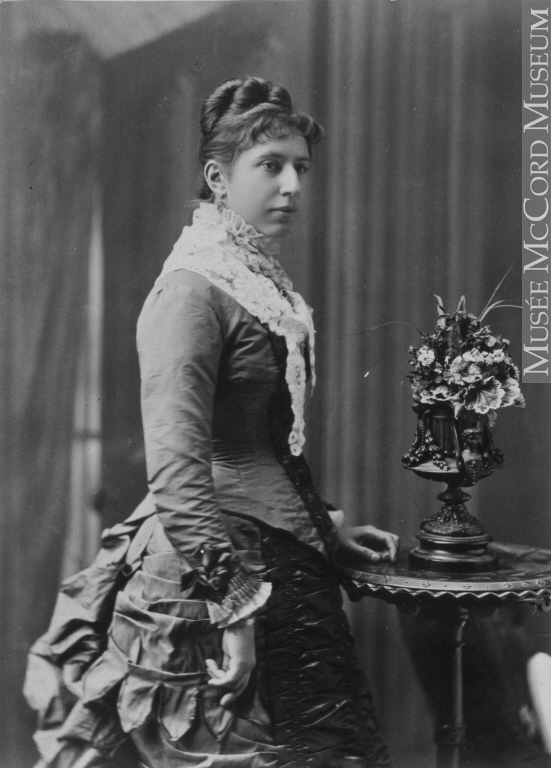
Miss Amelia Bagg, 1880

All four of the daughters developed an interest in the family real estate business that their brother was managing. They sometimes discussed which lots to sell, when and for how much. For example, in 1898, Katharine (Bagg) Mills wrote her brother: “Dear Stanley, I have seen my sisters and I think we all agreed that it would be well to sell the Villeneuve property if possible. The price to be asked, twenty five thousand dollars.”10

SCB’s widow was also still involved in decisions about the Bagg Estate some 27 years after his death. In 1900, Robert Stanley Bagg decided to retire from administering the estate. In response, Catharine Mitcheson Bagg wrote her son: “Dear Stanley, Acting upon your suggestion, I requested a family council and the Mills kindly invited all concerned to a little dinner…. We all came to conclusion that if McIntosh would accept the office of administration Bagg Estate, he would be the best man.”11 She went on to say that she planned to invite Mr. McIntosh to her house for a personal interview.

But the family member who demonstrated the most longstanding interest in the family’s real estate business was daughter Amelia Bagg (1852-1943), wife of 1) Joseph Mulholland and 2) Rev. John George Norton. She started a ledger in 1891 to keep track of lots that had originally belonged to John Clark’s Estate, including Mile End Farm and the Durham House property, as well as other parts of her late father’s estate.12 She quietly recorded property sales, prices and interest payments for 36 years.

Photo credit:

Miss A. J. Bagg, Montreal, QC, 1880, Notman & Sandham, 1880, II-58525.1, McCord Museum

Notes:

  1. Bettina Bradbury. Wife to Widow. Lives, Laws and Politics in Nineteenth-Century Montreal. Vancouver: UBC Press, 2011, p. 169. 
  2. I refer to Stanley Clark Bagg as SCB in order not to confuse him with his father, Stanley Bagg (1788-1853), or his son, Robert Stanley Bagg (1848-1912).
  3. Henry Griffin, “Last Will and Testament of Mr. John Clark of Montreal,” 29 August, 1825, # 5989, Bibliothèque et Archives nationales du Québec. 
  4. Joseph-Augustin Labadie, “Last Will and Testament of Stanley Clark Bagg, Esquire,” 7 July 1866, #156785. Bibliothèque et Archives nationales du Québec.
  5. “An Act to authorize the Executors of the will of Stanley C. Bagg, Esq. late of the City of Montreal, to sell, exchange, alienate and convey certain Real Estate with substitution in said will, and to invest the proceeds thereof.” Statuts de la province du Québec, 38 Victoria 1875, p. 474-477. 
  6. Yves Desjardins, Histoire du Mile End. Quebec: Septentrion, 2017. 
  7. John Fair, “Deed of Partition between Robert Stanley Clark Bagg and Dame Katharine S. Bagg, wife of Reverend William L. Mills, et al”, 10 Sept. 1891, #3100, McCord Museum, Bagg Family Fonds, B070/
  8. Katharine Sophia Bagg, Amelia Josephine Bagg, Mary Heloise Bagg and Helen Frances Bagg all engaged in the real estate business in their own names, primarily by leasing houses and selling lots. A search of their names in the “Quebec, Canada Notarial Records, 1637-1935” collection on www.ancestry.ca makes this clear. A search for their maiden names will bring up several dozen hits for each of them, including marriage contracts, sales, leases, loans and other records. In a few cases, the actual document has been digitized, but in most cases you can only view the notary’s index. See also Gail Dever, “How to order a notary record from the Quebec Archives after finding it in an index on Ancestry,” Genealogy a la Carte, Sept. 1, 2017, https://genealogyalacarte.ca/?p=20640. In a previous post, Gail explained how to find documents concerning your ancestors in Ancestry’s Quebec notaries collection. See http://genealogyalacarte.ca/?p=16551. To learn more about searching Quebec notarial records, see https://www.familysearch.org/wiki/en/Quebec_Notarial_Records
  9. O’Hara Baynes, Lease, 21 Jan 1897, #9938, Bibliothèque et Archives nationales du Québec. 
  10. Katharine (Bagg) Mills, letter to Robert Stanley Bagg, February 25, 1898, McCord Museum, Bagg Family Fonds, B070/
  11. Catharine Mitcheson Bagg, letter to Robert Stanley Bagg, Oct. 6, 1900, McCord Museum, Bagg Family Fonds, P070/
  12. Amelia J. (Bagg) Mulholland. Ledger, 1891-1927. McCord Museum, Bagg Family Fonds, P070/B07.