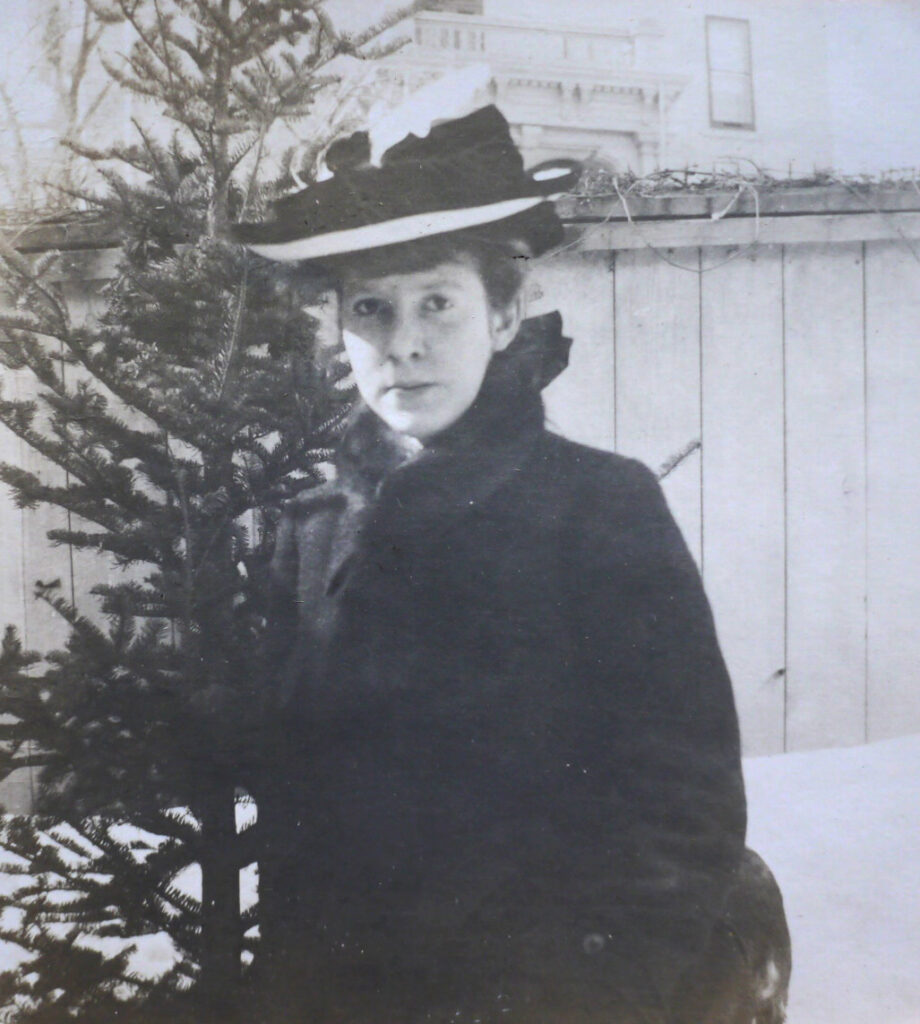
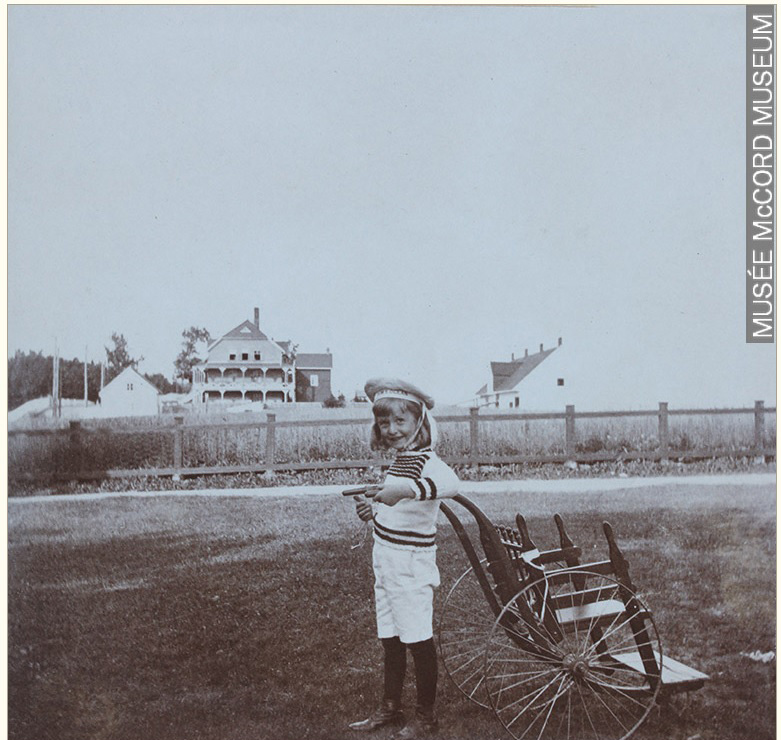
According to the Dictionary of Canadian Biography, my great-great-grandfather Stanley Clark Bagg had one son, Robert Stanley.1 That is a true statement, but I suspect his four daughters would take issue with their omission from the article.
In fact, Stanley Clark Bagg and his wife Catharine Mitcheson had one son and five daughters, although their first-born died at age two. Their children were: Mary Ann Frances (1845-1847), Robert Stanley (1848-1912), Katharine Sophia (1850-1938), Amelia Josephine (1852-1943), Mary Heloise (1854-1938) and Helen Frances (1861-1935.) All four of the girls appear to have been independent, intelligent and strong-willed.
Stanley Clark Bagg (1820-1873) inherited a vast expanse of property in Montreal from his maternal grandfather and he seems to have supported the family primarily on rental income. The land consisted of several adjoined farms on the east side of Mount Royal, north of the city limits. The family lived in a big house called Fairmount Villa near what is today the corner of Sherbrooke Street and Saint-Urbain.
Stanley had worked as a notary for about 10 years, then devoted himself to managing his properties. He also had time to follow his many intellectual interests, including numismatics (the study of coins) and archaeology, and to write about them. He became well known in Montreal, not only because of his extensive landholdings, but also as an author and a philanthropist.
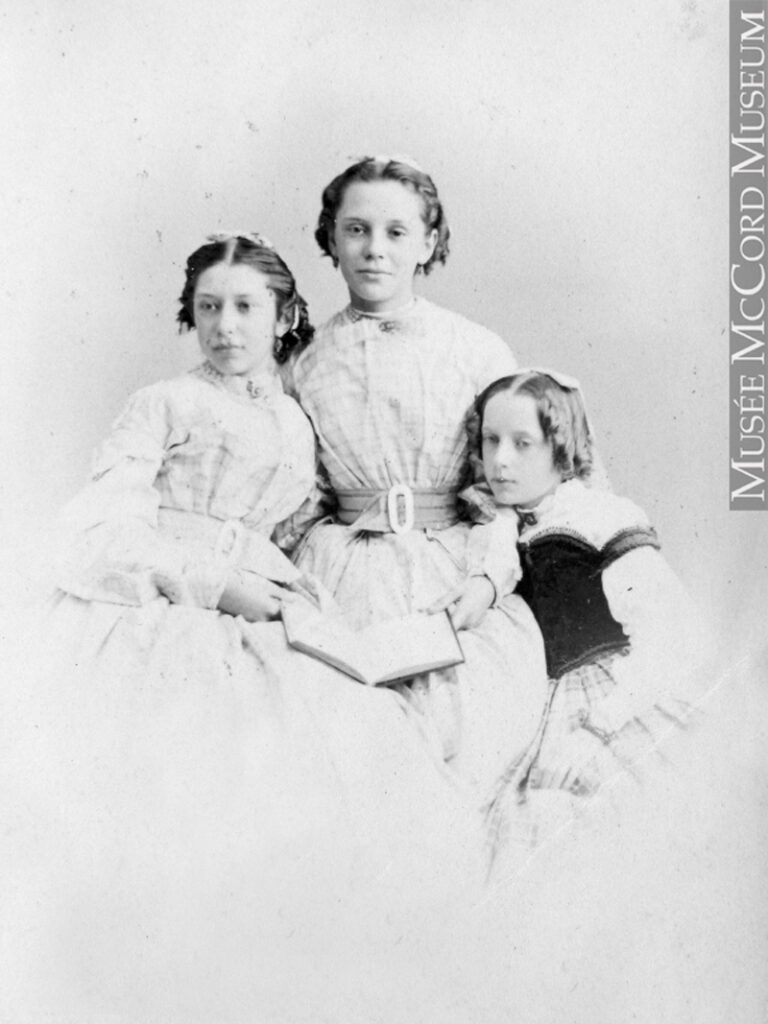
Stanley and Catharine placed great importance on the children’s education, and the whole family took a grand tour of Europe in 1868-69, visiting museums, cathedrals and ancient sites in Pompeii, Paris and other locations. This interest in travel, history and the arts must have rubbed off on the girls because Katharine and Helen were both writers and Amelia was an amateur artist.
Stanley’s sudden death from typhoid at age 53 came as a shock to all, and a colleague at the Numismatic and Antiquarian Society of Montreal wrote an obituary that was published in the society’s journal. Other local historians also wrote about Stanley Clark Bagg’s life and family history, but these accounts contained several inaccuracies and completely omitted mention of his daughters.
As part of my effort to correct the historical record, here is a brief outline of the lives of the forgotten Bagg girls:
In 1886, Katharine married Rev. William Lennox Mills (1846-1917), an Anglican clergyman who served as Bishop of Ontario from 1901 to 1917. The couple lived in Kingston and had one son, Arthur Lennox Stanley Mills. Around the turn of the century, Katharine and her husband visited Europe and the Holy Land and she wrote a small book about their travels.3
Amelia married twice. In 1890, she married Joseph Mulholland (1840-1897), a real estate agent with the Bagg family business. Five years after Joseph died, she married John George Norton, a widower who was Anglican Archdeacon and Rector of Montreal. Amelia had no children of her own, but my mother remembered her fondly and she seems to have been the go-to member of the family in troubled times.
Amelia was also involved in the family real estate business, selling and leasing properties, but her most important legacy was a ledger she kept from 1891 to 1927, in which she recorded land sales and other accounts related to the Estate. She is buried with her first husband in the Workman family plot in Montreal’s Mount Royal Cemetery.
Mary Heloise married Montreal stock broker Robert Lindsay (1855-1931). They lived in downtown Montreal and had five children: Ada, Lionel, Marjorie, Stanley and Marguerite.5 Lionel, a gentle pediatrician, was the only member of the family I knew. Mary Heloise is buried in the Lindsay family plot in Mount Royal Cemetery.
Helen Frances was considerably younger than her brother and sisters and was only twelve when her father died. Educated in Canada, England and Europe, she led an adventurous life.When her first husband, Edward Albert Lewis (1860-1908), an agent in the Bagg family real estate company, disappeared in 1898 owing large sums to his brother-in-law, Helen tracked him down in the Far East. The couple started over in Vancouver, where Albert became a successful real estate agent and Helen a pillar of society. After Albert died, Helen married Herbert Drummond (1864-1938) and the pair travelled the world.6
According to a 1930 article about Helen published in Women of Canada, she wrote magazine articles about her travels, but it was probably under a pseudonym and I have yet to find any of them. She had no children and is buried in Vancouver.
Photo Credit:
Misses Bagg, Montreal, QC, 1865, William Notman (1826-1891), 1865, I-18254.1
© McCord Museum
<a href=”http://collections.musee-mccord.qc.ca/en/collection/artifacts/I-18254.1/” title=”More information about this image”><img src=”/largeimages/I-18254.1.jpg” width=”576″ height=”768″ alt=”Photograph | Misses Bagg, Montreal, QC, 1865 | I-18254.1″ /></a>
Notes:
- Pierre Landry, “Bagg, Stanley Clark,” Dictionary of Canadian Biography, vol. 10, University of Toronto/Université Laval, 2003–, accessed September 29, 2017, http://www.biographi.ca/en/bio/bagg_stanley_clark_10E.html Janice Hamilton, “Don’t Believe Everything You Read,” Writing Up the Ancestors, Dec. 2, 2015, https://www.writinguptheancestors.ca/2015/12/dont-believe-everything-you-read_2.html
- These births, marriages and deaths can be searched in the Quebec, Canada, Vital and Church Records (Drouin Collection), 1621-1968, available on www.Ancestry.ca. These events are also recorded in the Bagg family bible, which is part of the Bagg Family Fonds at the McCord Museum in Montreal.
- Mrs. W. Lennox Mills, Reminiscences of a Cruise in the Mediterranean and a Visit to the Holy Land and Egypt,1910.
- Amelia Josephine Bagg Mulholland, Ledger, 1891-1927, McCord Museum, Bagg Family Fonds, P070/B07.
- Lucy Anglin, “Great Granny Bagg,” Genealogy Ensemble, Feb. 10, 2016, https://genealogyensemble.com/2016/02/10/mary-heloise-bagg-lindsay-1854-1938/
- Janice Hamilton “Helen Frances Bagg: A Happy Exile,” Writing Up the Ancestors, Jan. 6, 2016, https://www.writinguptheancestors.ca/2016/01/helen-frances-bagg-happy-exile.html.